

How To Draw A Ocean Wave
This surf art tutorial is brought to y'all by Bob Penuelas, an illustrator famous for his surfing comic strip, Wilbur Kookmeyer. Created past Bob Penuelas in 1986, Wilbur Kookmeyer was a regular two-page feature in Surfer Magazine, gaining a cult following in the surfing community.
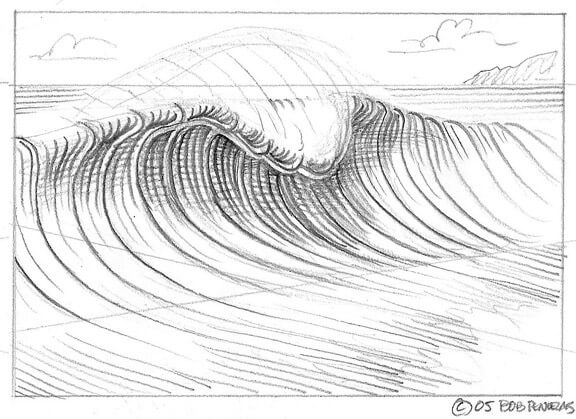
You lot probably spent a lot of time in high school, or at work, heedless and doodling a thousand perfect cartoon waves in your notebook. This tutorial volition assistance you modify your throw-away moving ridge doodles into works of art you'll want to keep forever.
Remember, at that place are many ways to draw a wave, this tutorial only covers a few techniques, but hopefully, with these simple pointers, you'll notice many more ways to draw a wave. Have fun!
P.S. If you lot're looking for inspiration, check out these surfing illustrations.
Cartoon a basic moving ridge
The following illustrations and captions by Bob Penuelas accept you through the basic steps of drawing a wave.
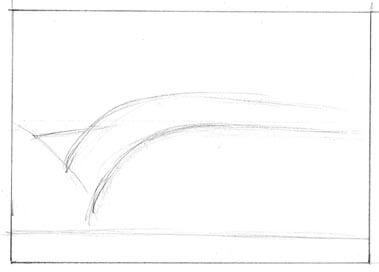
Step 1
Sketch in the basic shape of the curl, spray, foam and base of operations of the wave.
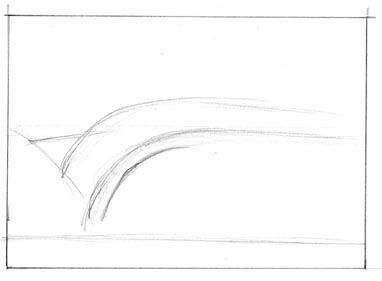
Pace 2
Add an actress line running parallel and below the curl line to define the thickness of the lip.
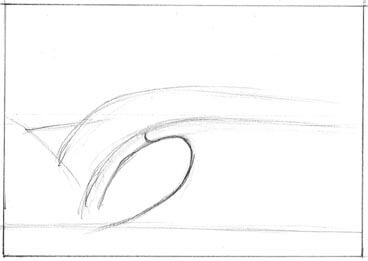
Footstep 3
Add together a flow line starting at the lip and bend it around to advise roundness of the liquid lip. Keep that same flow line around with a half oval down to the base of the wave to evidence the concave curve of the wave face.
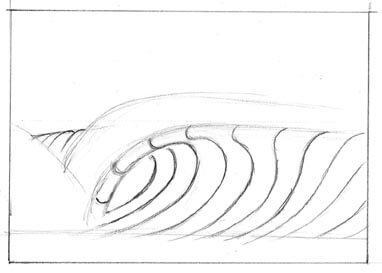
Footstep 4
Add the residue of the flow lines. Gradually make each flow line less steep as you move away from the curl, to show the tapered shoulder. Go along the flow lines into the tube to bear witness hollowness.
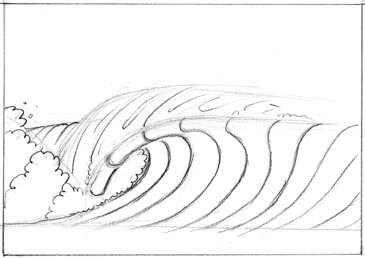
Step 5
Add simplified spray with thin wispy lines. Add the foam explosion with a series of explosion lines getting bigger as they moving away. Peradventure add together a cream ball in the tube. Round off the foam at the base of the moving ridge so it won't expect flat.

Step 6
Add shading on the wave face with smaller contour lines. Gradually brand the lines darker as you get farther into the tube. Use crosshatching to add more depth. Lightly shade foam and base of the moving ridge. Maybe shade the sky a little, also.
Tips
- Don't become caught up trying to describe every cream chimera, you'll go nuts.
- Using a sharp eraser, keep a divers white line under the lip so information technology looks divide from the wave face.
- Add together white highlights on the lip with your eraser to give information technology sparkle.
The importance of perspective
Drawing a basic moving ridge can be fun, but later on a while information technology can go boring if you are merely following the aforementioned formula over and over again. The central to breaking out of this potential rut is achieved by drawing waves from dissimilar angles. There is just i style to successfully create a variety of angles and that is past using the basic principles of perspective. The ii basic ingredients in perspective are the horizon line (your eye level) and the imaginary vanishing points. By just irresolute the position of these ingredients in your image you'll be amazed at the diversity of waves you tin create. See the two sketches below:
A paddler's view
Depression horizon. Vanishing point off left:

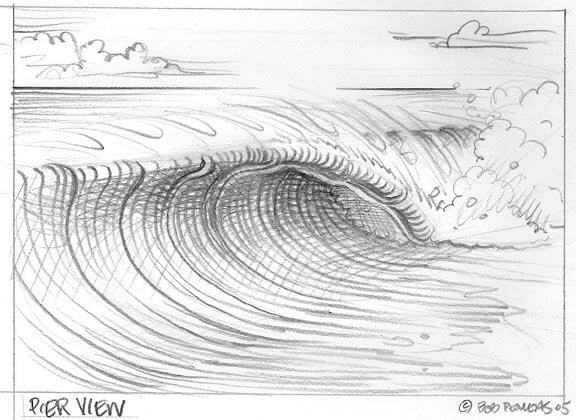
A pier view
Loftier horizon. Vanishing bespeak left:

A view into the tube
Additional variations tin can be achieved by moving the horizon line loftier or depression and by moving the vanishing point right or left. Requite it a try:

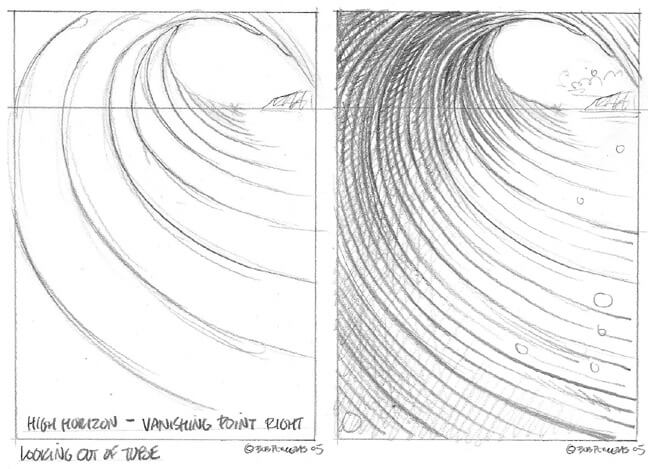
A view out of the tube
A high horizon line and 1 vanishing point on the left makes it expect as if your face is against the confront of the wave and you lot're racing for daylight (see first two images below). And if you move the vanishing point to the correct then more than of the face becomes visible (see last two images beneath):

A view from a pier
A high horizon line with ii vanishing points off to the right and left makes it appears as though you're viewing the wave from a pier, looking downwardly on the wave:
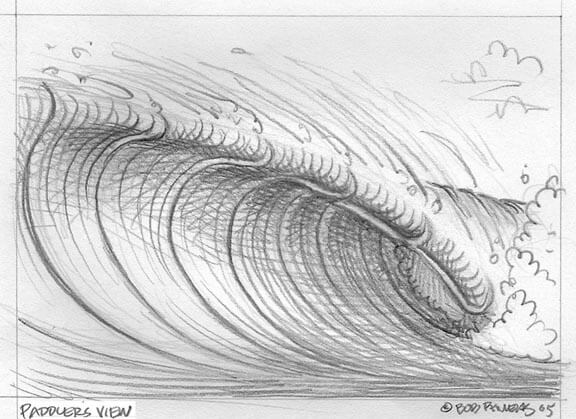
A paddler'south eye view
A paddler's center view tin be accomplished by placing the horizon line extremely depression. Both vanishing points are located outside of the prototype border, one to the left and one to the right:
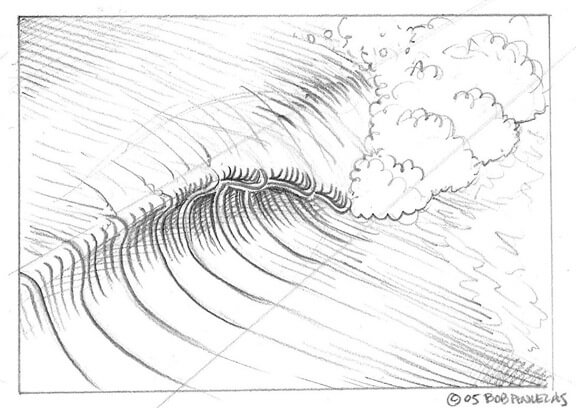
A bird'southward center view
A bird's eye view tin can be achieved by moving the horizon line upward and completely off the image. The 2 vanishing points are positioned way out to the right and left:
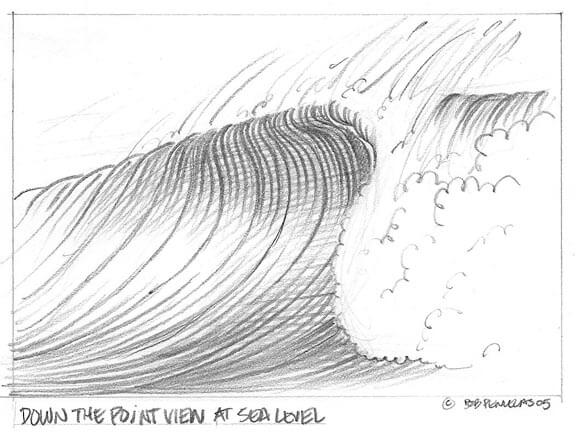
A down the point view
A view looking down the point can also be achieved by moving these ingredients around:
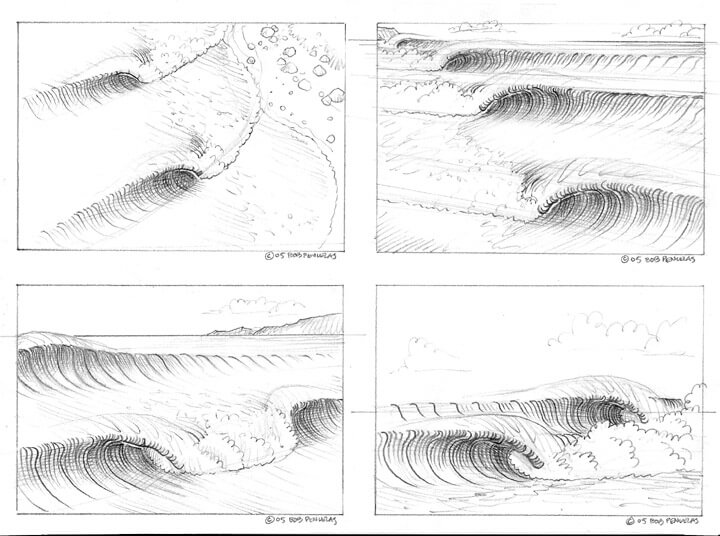
Various scenes
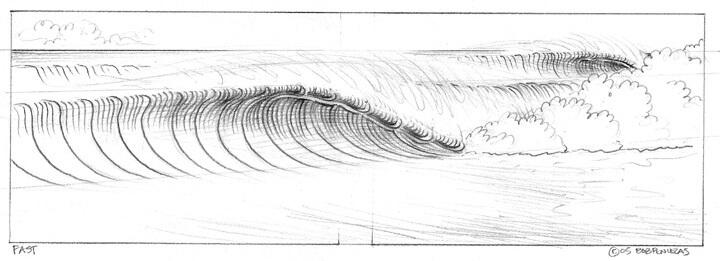
With perspective, you tin can now create line-upwards scenes, with multiple waves. It could exist a reef pass, a embankment suspension or a point intermission Add land in the groundwork or in the foreground to give the scene some depth. See the four sketches beneath:
Dissimilar types of waves
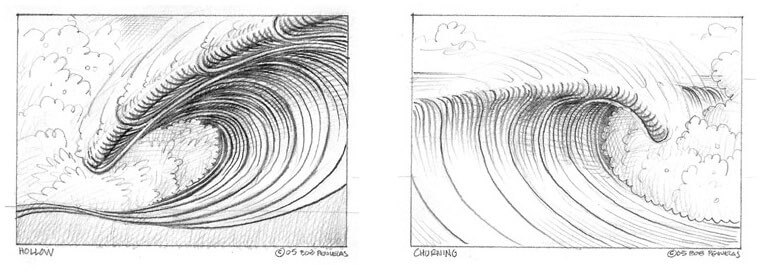
Don't forget about hollow waves, freight-trains, slow-churning or cardboard waves. The possibilities are endless:
Peaks
Avoid drawing a peak past merely attaching two mirror image waves together. The right and the left are the same yet they are drawn differently.
Add surfers
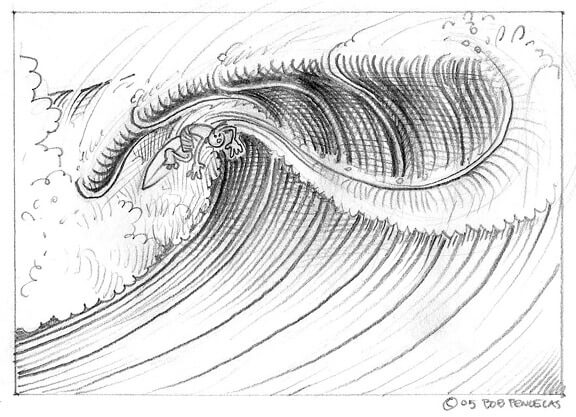
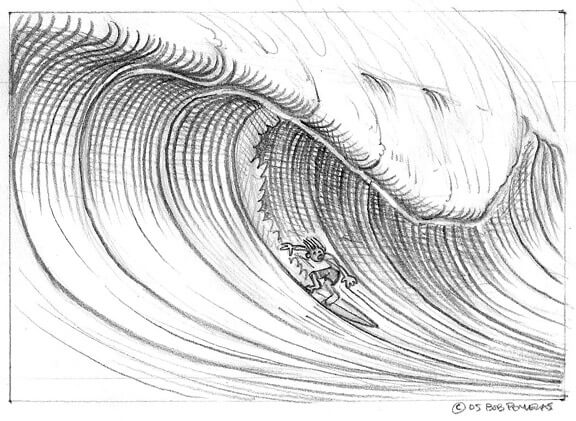
Don't forget to add surfers to your waves, whether y'all describe them regular or goofy foot, backside or frontside, you soon realize that there are endless combinations. See the three sketches below:
A surfer doing a cutback on a wave:
A surfer riding a big moving ridge:
A side profile drawing of a surfer riding a barrelling wave:
If y'all enjoyed this tutorial, please share information technology with your friends and followers. And share your drawings with us on Instagram or Twitter.
Curated past Bob Penuelas on Jun 24, 2008

Source: https://clubofthewaves.com/feature/how-to-draw-a-wave/
Posted by: cashhincir.blogspot.com
0 Response to "How To Draw A Ocean Wave"
Post a Comment