

How To Draw A Realistic Robot
How to Draw Trees
Updated: 24 Feb 2022
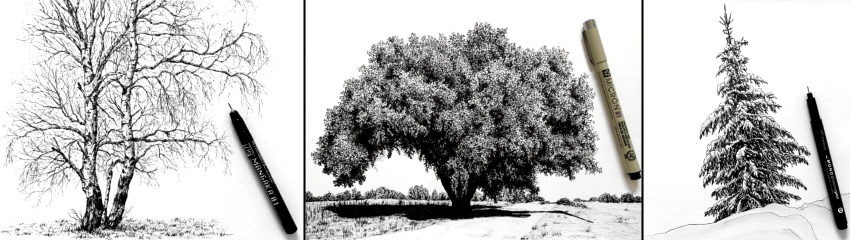
In this guide, I will demonstrate how I simplify the drawing procedure, and I hope that by the finish of it you volition exist able to depict your favorite tree.
In order to draw realistic trees with pen and ink, information technology is important to pay attending to accuracy of the form (construction), and to learn how to create the illusion of effulgence values and transitions with pens.
Bamboo
When looking at ANY tree, examine its basic shapes.
It is a expert practice to draw its unproblematic shapes get-go:
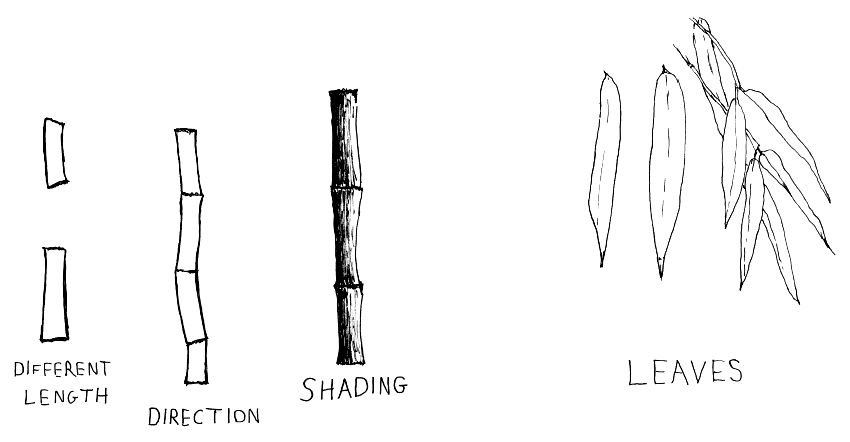
One time you understand these simple shapes, you tin employ your creative license and your knowledge to recreate it.
There is no indicate cartoon every single leaf as you see it (when using a reference image equally a guide).
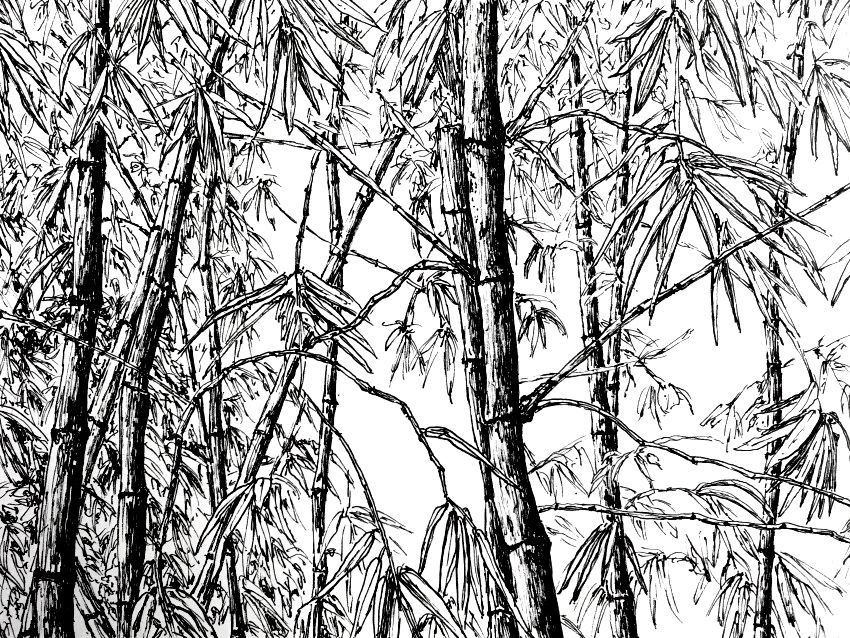 Bamboo
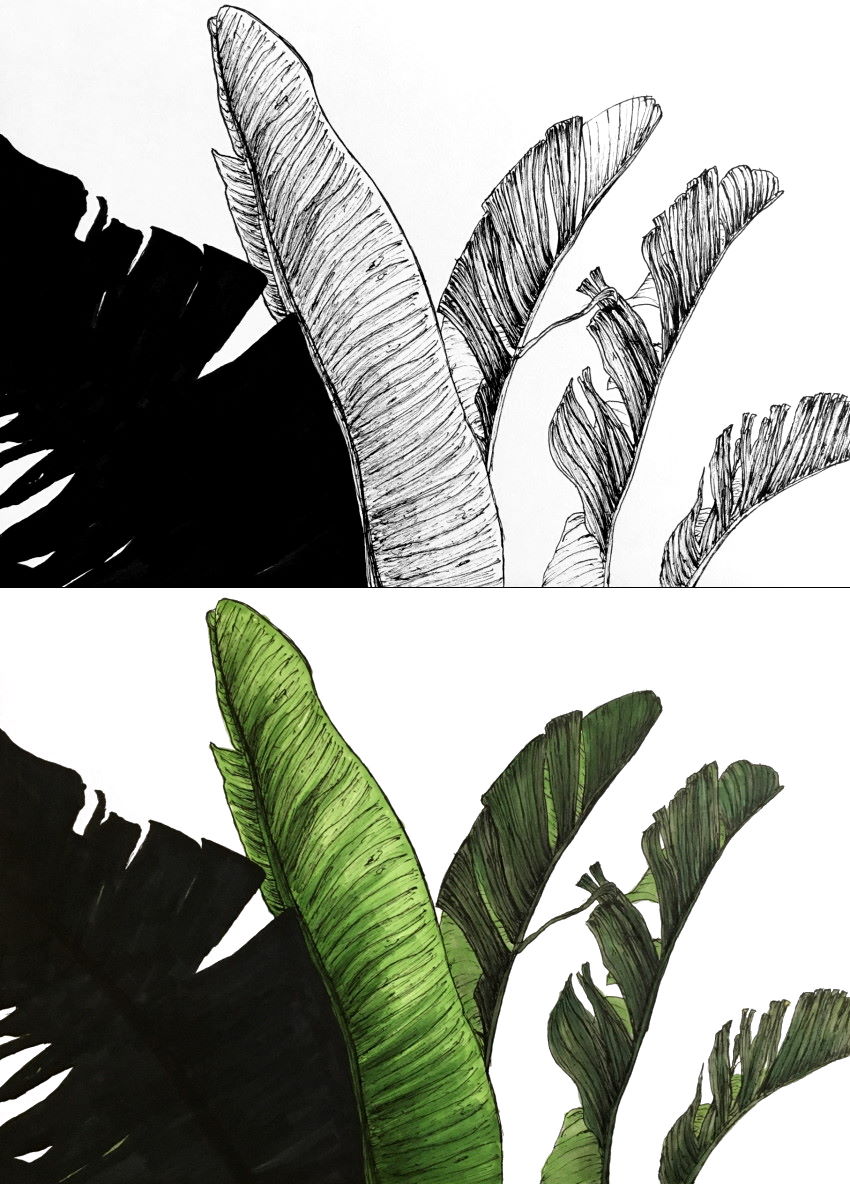
Banana Tree
For trees with big leaves, like a banana tree, get-go depict a study of the leaves from unlike angles.
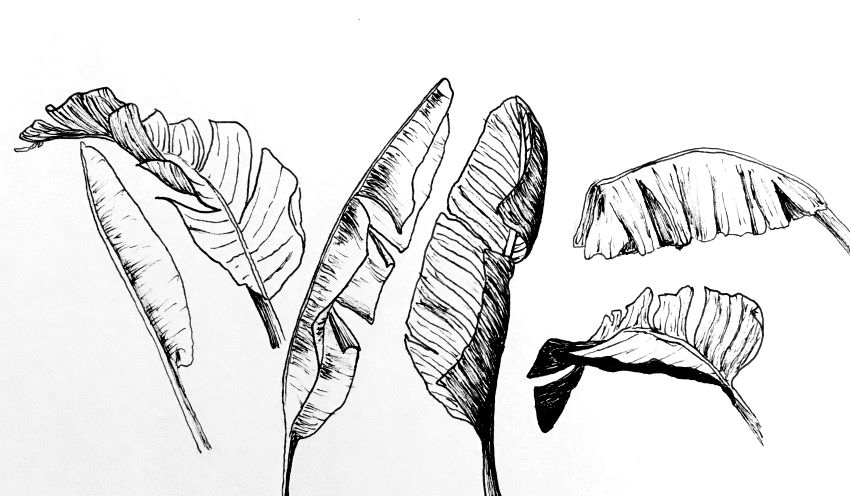
For a realistic result, make sure there is no symmetry, and that each leaf is unique.
You can use markers; they work well with pens.
Olive Tree Torso
Await at some reference images, or actual trees, before drawing the tree torso.
Outset, draw outlines to create the form (structure).
Recall:
Draw thin and gentle outlines, then they are not bold.
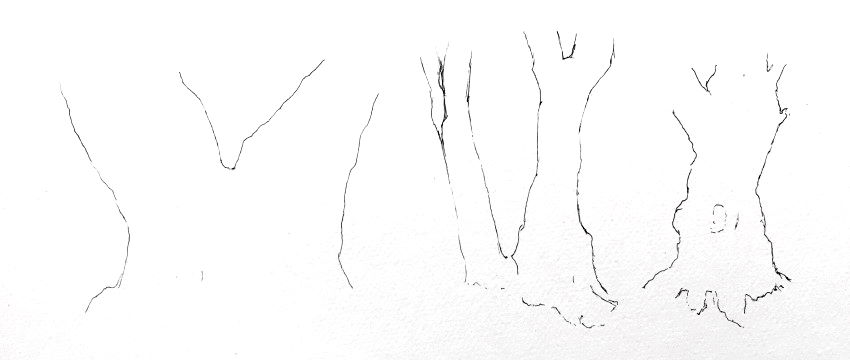
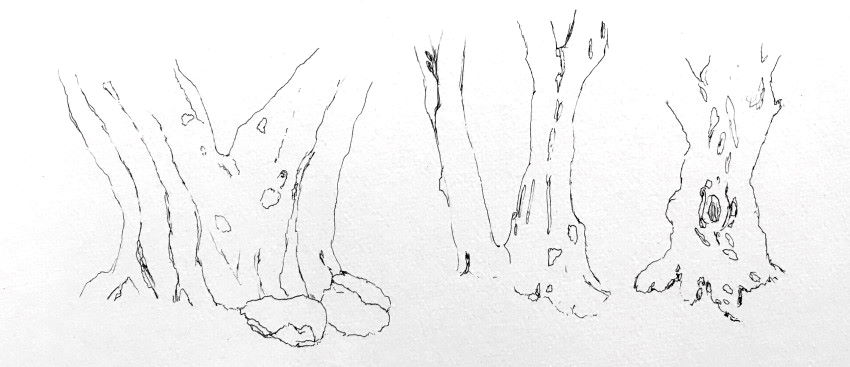
Adjacent, add some guidelines and basic details.
Last step is texture drawing.
Focus mainly on brightness values, while drawing marks with shape and direction like the reference epitome.
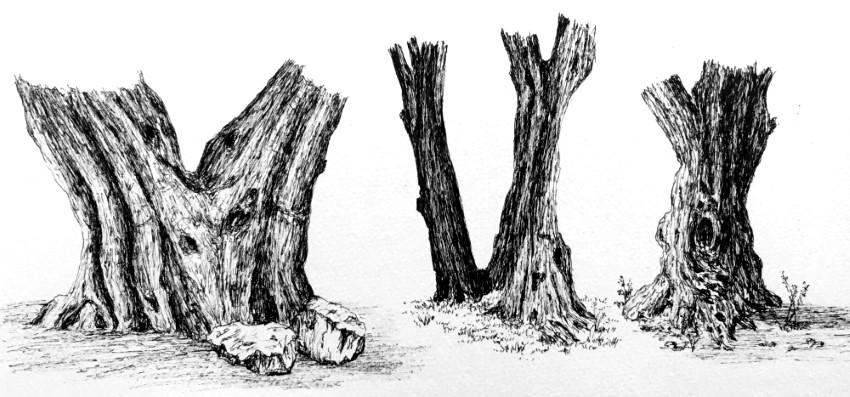 Olive tree trunks
Keep in listen:
Each olive tree trunk has its own "personality", but all olive copse share common bones shapes.
How to Draw Leaves
Drawing leaves can be challenging. Agreement their structure, and breaking the drawing process into steps, will produce a satisfying and realistic result.
Each tree foliage is in dissimilar direction, has a unlike degree of foreshortening, and is overlapping other leaves.
Simply put, the form and texture of leaves is abstruse and messy.
To draw that, you need to be sketchy and loose with your marks, and to avoid any blueprint!
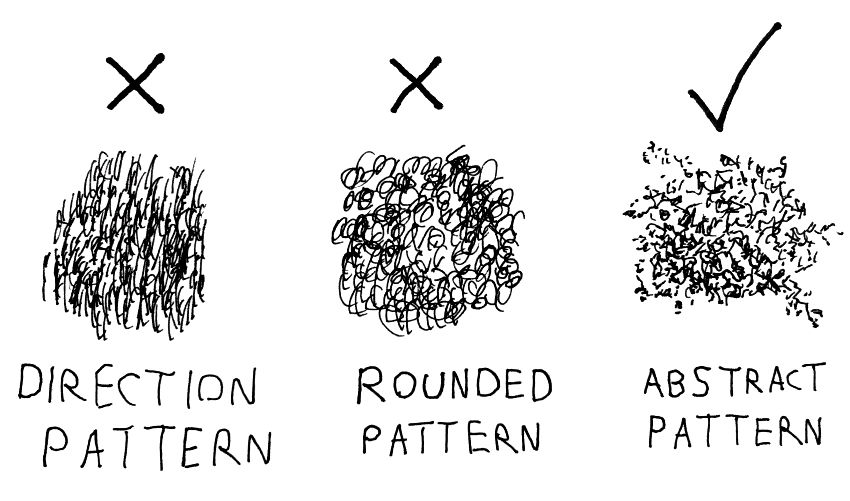
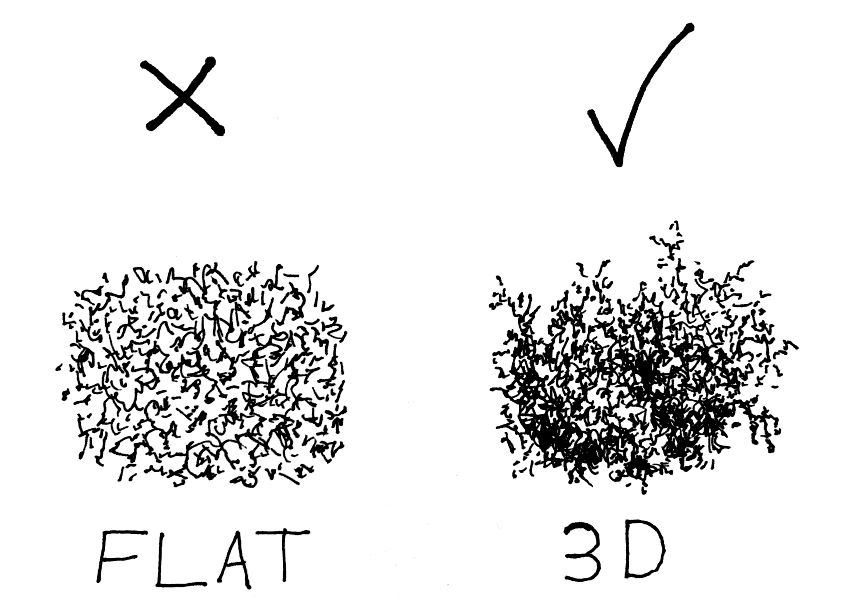
Side by side step is to pay attention to brightness values. That is how you create the illusion of volume. Meaning, 3-dimensional and not apartment.
To create that illusion, scribble more lines for darker values, and fewer lines for brighter values:
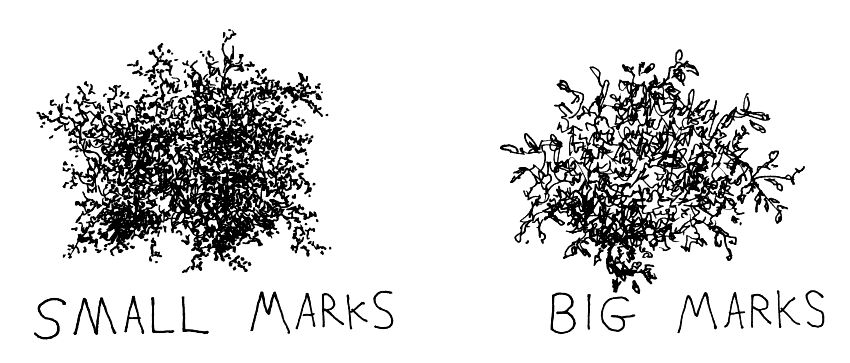
In improver, pay attention to leaves size, depending on the tree type, and how afar information technology is from the observer.
For big leaves, sketch large marks, and vice versa:
While the treetop is messy, at its edges you can add together some indication of leaves type and size.
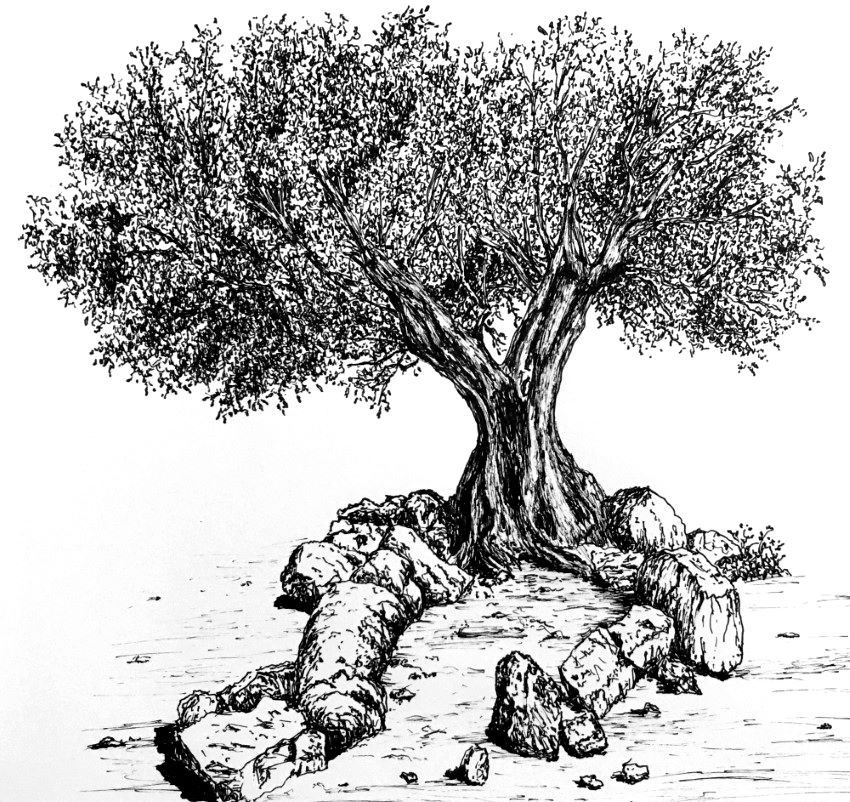 Olive tree
Afterwards understanding the characteristics of a specific tree (olive tree in this instance), it is quite easy to draw it from imagination.
If some terms like foreshortening and overlapping are new to you lot, read my guide on how to draw with a sense of depth. It covers 15 methods to add depth to your drawing or painting.
Good to know:
By and large, I employ a pen with pecker size 0.1. It is small enough to create fine details.
Photos & Contrast
When I am taking photos of a tree, I do it from several angles.
If possible, I circle the tree to become a photo from every angle.
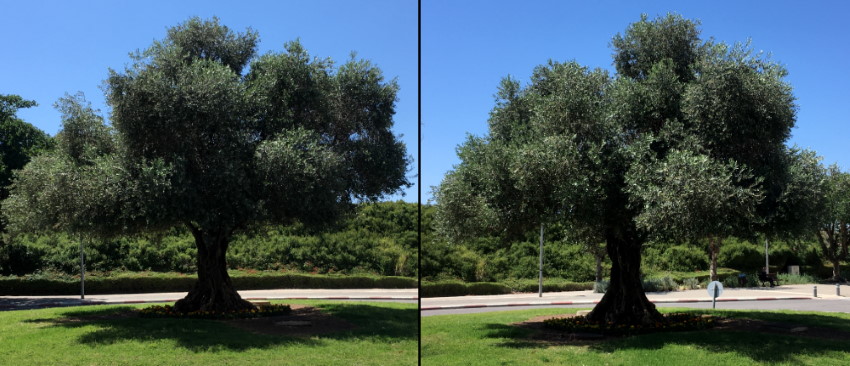
I select a photo that has loftier dissimilarity as my reference paradigm.
Dissimilarity between highlights and shadows is crucial for a cartoon to stand up out, and to have presence.
Not enough contrast leads to a flat drawing with no depth. Besides much contrast looks cartoonish.
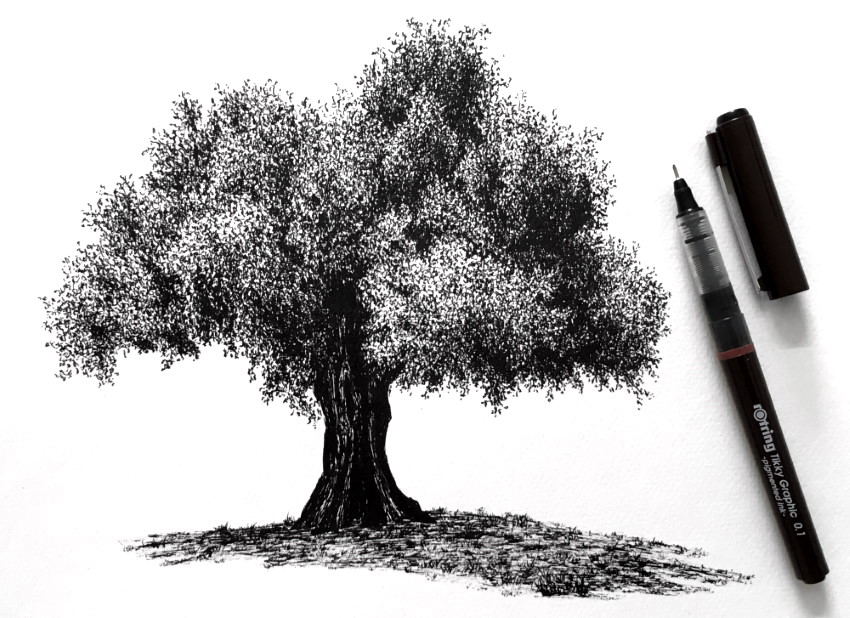 Olive tree
Pine Copse
Important:
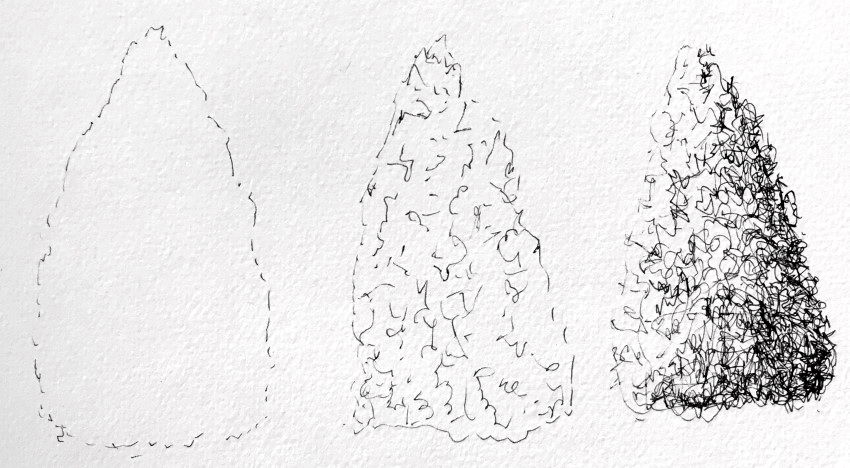
Before diving into complex texturing and rendering, if you are a beginner, you might desire to practice the adjacent pace.
Draw any random tree shape, sketch some random marks to fill up it upwards, so draw more sketchy marks in one side and at the bottom of the tree (to create a darker value for the shadow area).
This should non take more v minutes! The advanced texture yous will run into afterwards this example is but a matter of many hours of exercise to refine the texture marks.
Pine trees are relatively easy to draw from imagination.
They have very minor, needle-like leaves.
I like to first by gently drawing the form, and then fill it with small, random marks, that are Non in whatever specific direction or with reoccurring shape.
Final footstep is to draw more marks for darker areas, depending on the direction of light you choose.
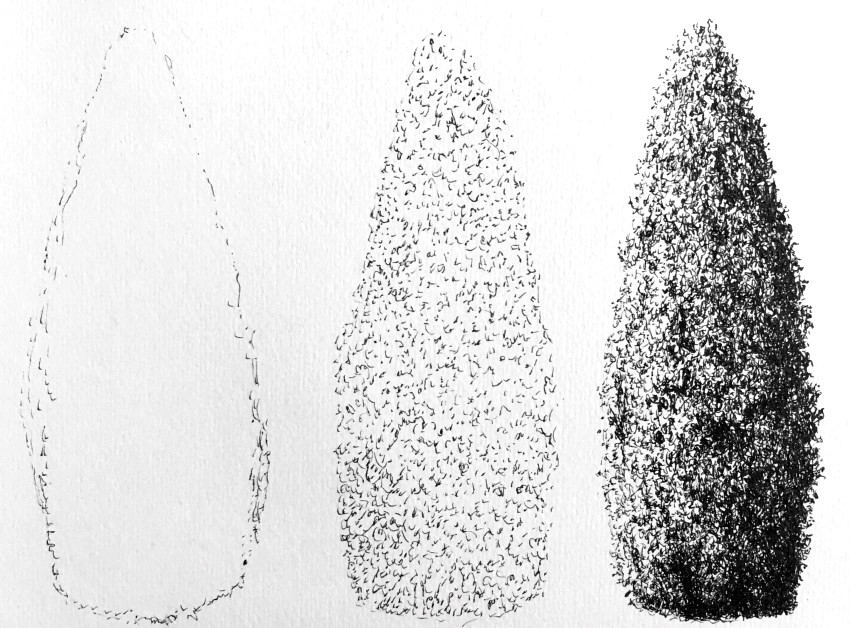
Pine trees come in many types and shapes.
Looking at a reference image tin can aid at the outset, just as a guide to draw the form, and to pay attention to dark and low-cal areas.
Other than that, effort to be loose and sketchy with your marks.
When drawing a close-up view, y'all tin indicate the needle-like leaves at the edges of the tree.
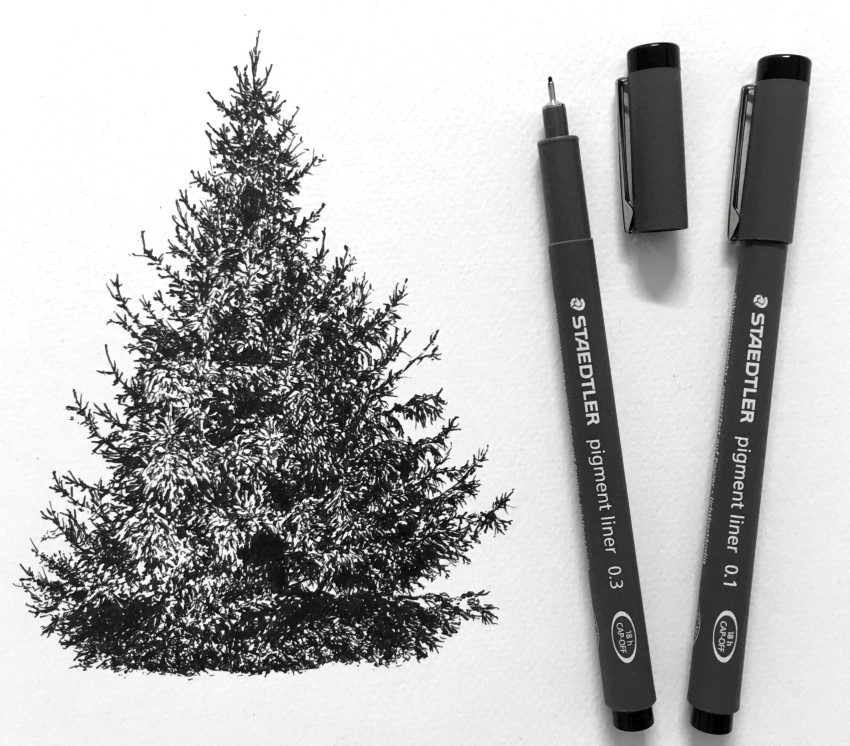 Pine tree
Snowy Pine Tree
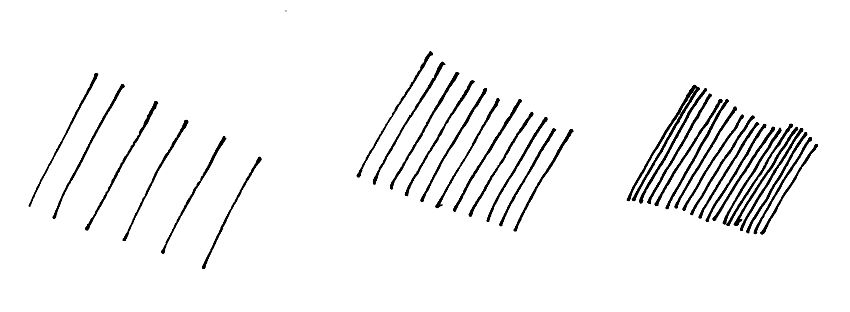
A pen has only ane effulgence value. Therefore, you have to use different techniques to create the illusion of transitions in effulgence values.
One technique (or style) is to utilize hatching. Hatching means drawing parallel lines.
By cartoon lines with unlike degree of spacing between them (or with different line width), yous can create an illusion of different effulgence values.
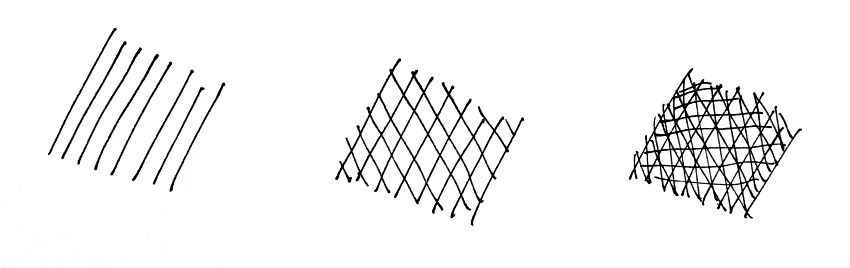
Another method is to use cross-hatching.
Cross-hatching means cartoon sets of parallel lines in different direction. By adding more sets of cross-hatching, y'all tin create the illusion of darker values.
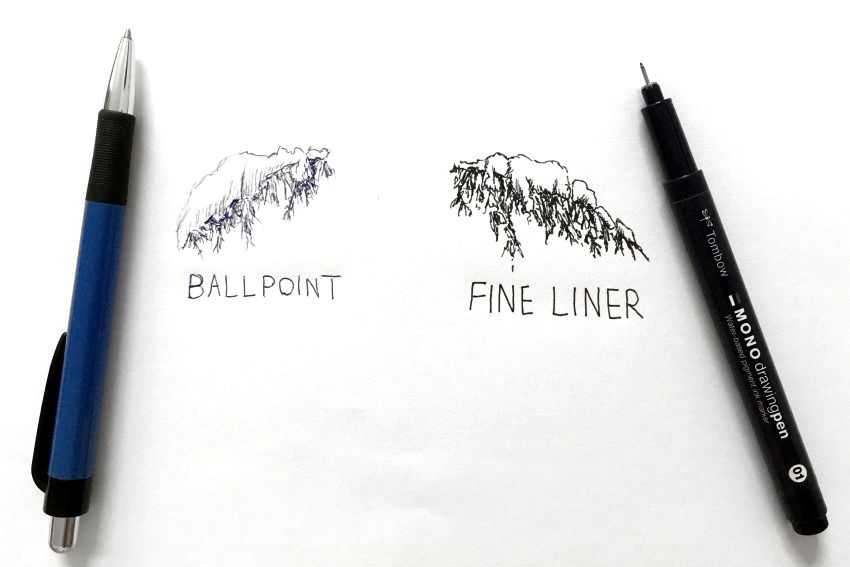
You tin employ ANY pen for drawing. I prefer artist-grade technical pens (also fineliners). They create lines with fixed width, and their ink is made of pigments, which is very durable and lightfast.
For the snowfall part, you lot can get out it empty ("white"), or you can use hatching in some areas.
In this example, I used some hatching, and some marks with very light gray marking.
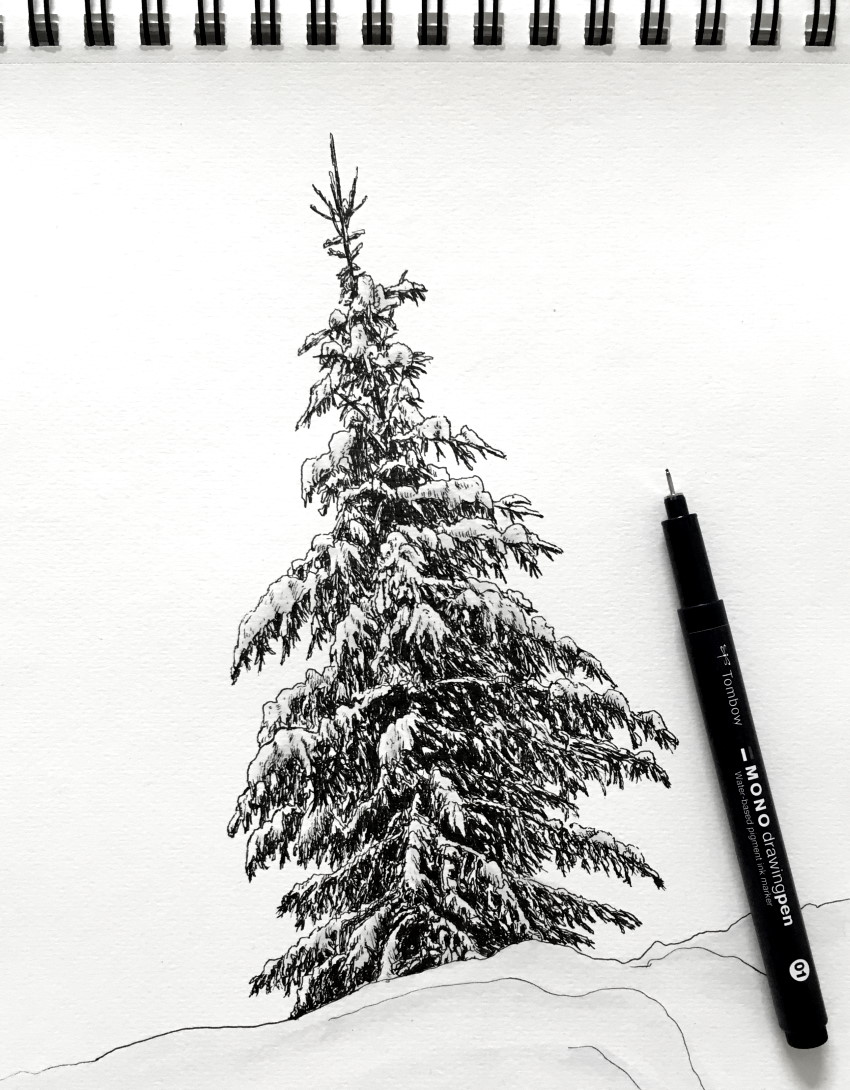 Snowy Pine tree
If you want to know more about markers, visit my markers review for artists.
Christmas Tree
A Christmas tree is only some other pino tree, but with decorations.
To add some baubles, start draw their shape, and so try different types of hatching, cross-hatching, and stippling.
Stippling is a drawing technique that uses dots. The more dots you lot add in one area, the darker it looks.
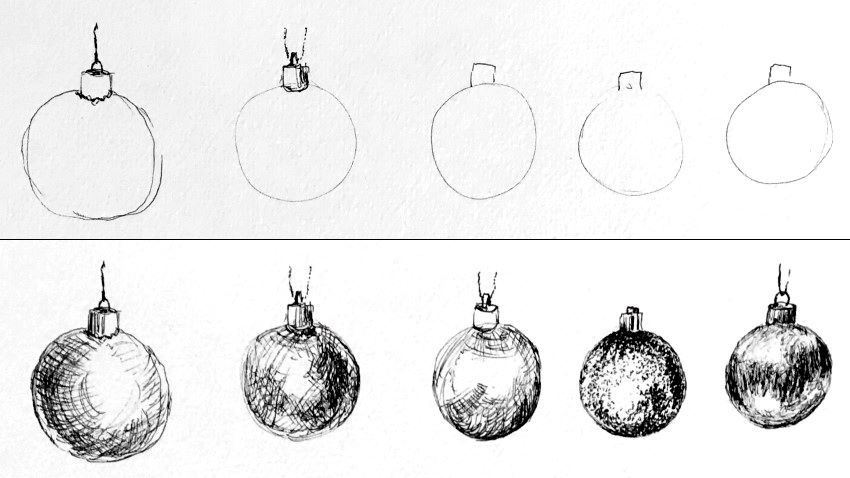
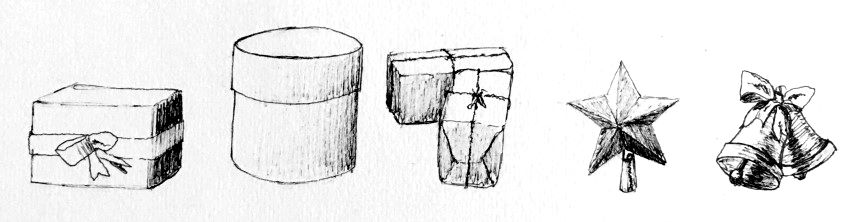
You tin add other decorations to your Christmas tree.
It is best to kickoff sketch some examination drawings on a different newspaper, to see what works, before adding them to your cartoon.
To add boxes in perspective, you should exist familiar with linear perspective drawing, and larn to draw from imagination.
Tip:
If y'all find it hard to draw a tree with a pen, you can always start with a pencil.
When you lot reach a satisfying result, you tin go over information technology with a pen, and gently erase the pencil marks.
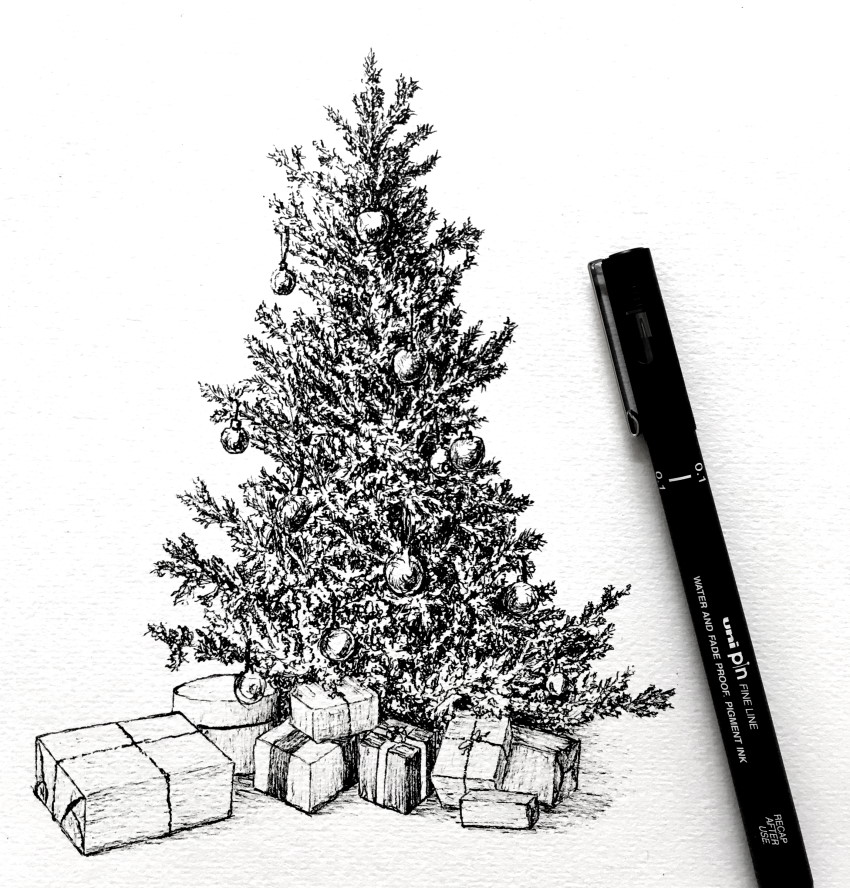 Christmas tree
Drawing with White Pens
When drawing with white pens, pay attention to the same drawing fundamentals.
While with black pens yous draw more than lines for darker areas, with white pens y'all should draw more lines for low-cal/vivid areas.
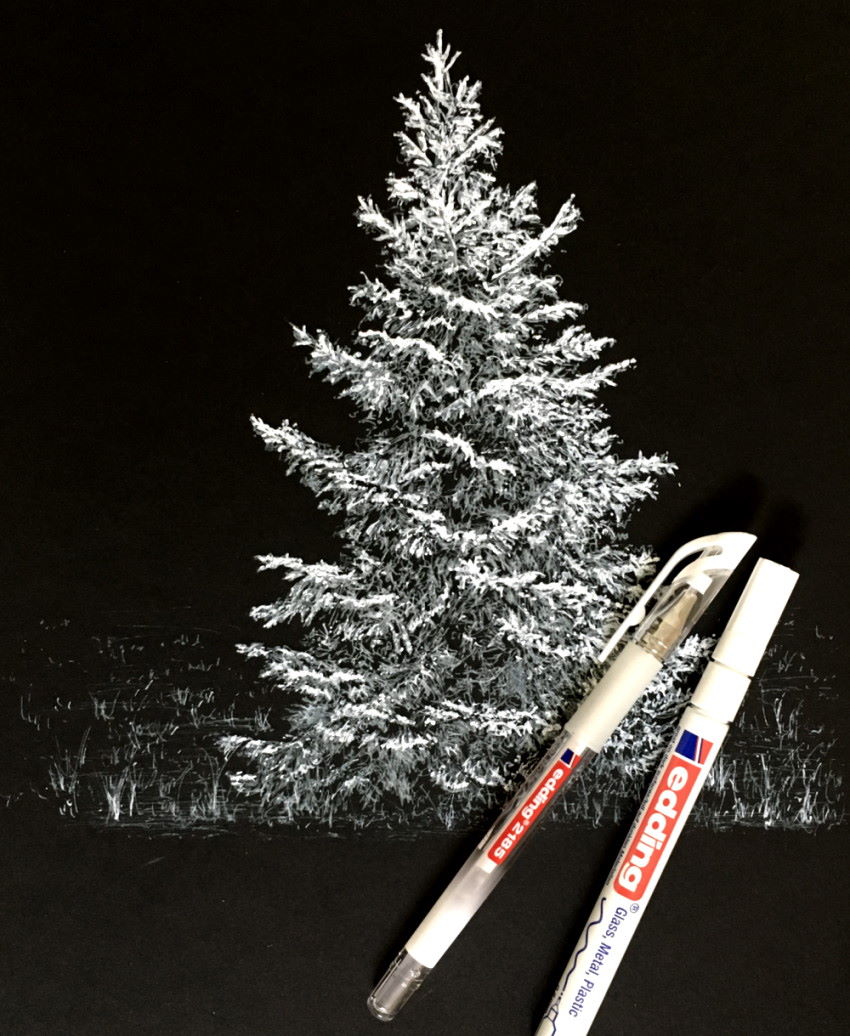
These pens are most effective on black (or nighttime) paper, and for highlights.
Continue in mind:
White pens are designed for covering.
Drawing with a black pen (which has ink) over white areas (made by a white pen), may ruin the pen's nib, because information technology will be covered with the white substance (therefore its ink will not flow smoothly).
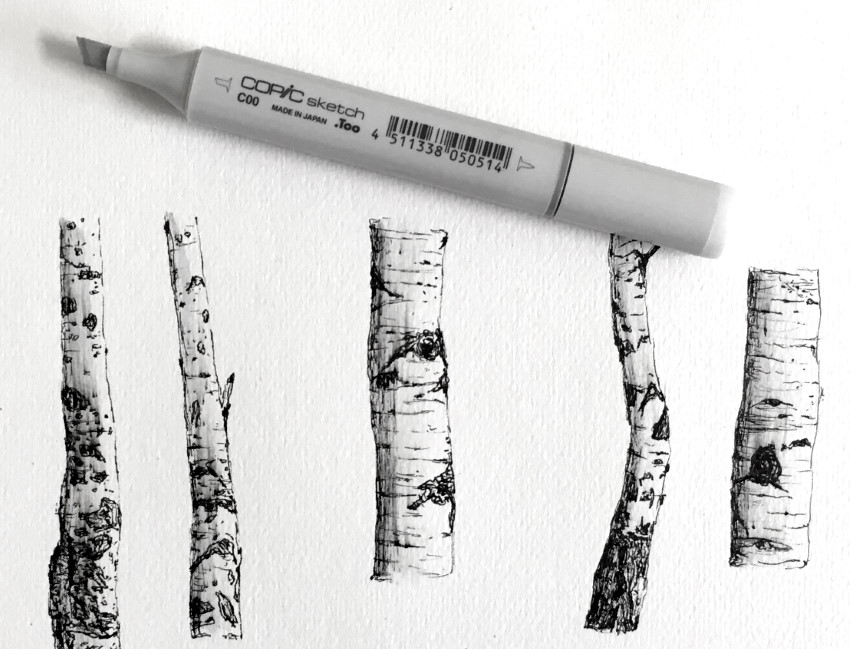
Aspen & Birch Trees
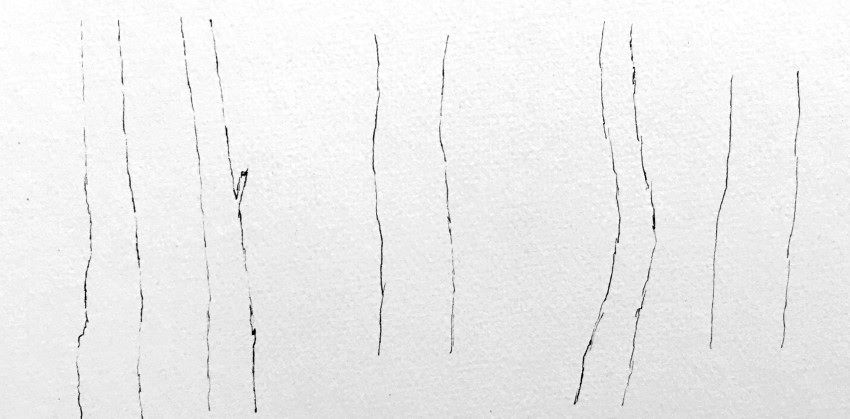
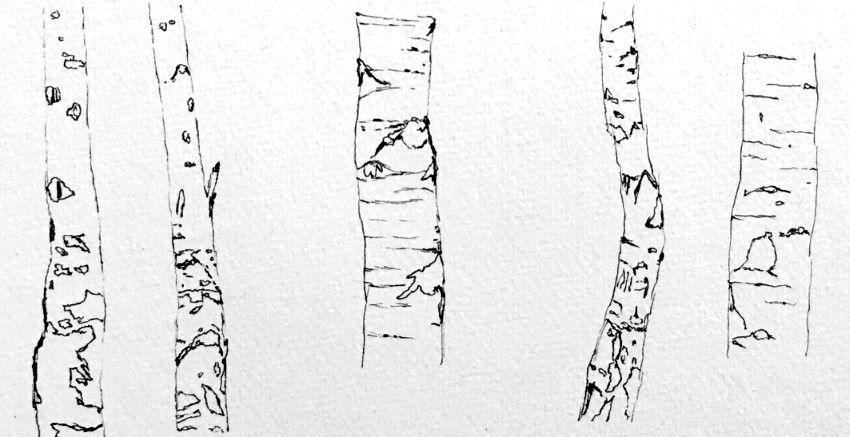
Aspen & birch tree trunks are easy to describe when doing it in steps.
Draw the form first:
Then, add some bones details:
Finally, depict some effulgence values, and texture:
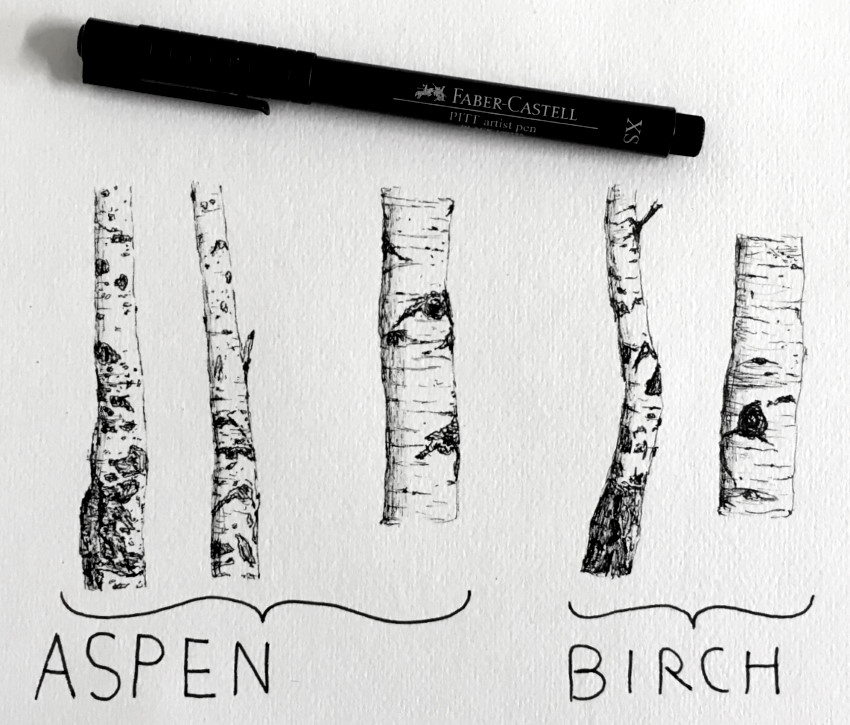 Birch & aspen tree trunks
You can use (calorie-free) grayness markers for coloring:
Overlapping
Overlapping means an object that partially covers some other object.
When you see an object that overlaps some other object, you assume that this object is in front of the object it covers.
Overlapping is 1 of the most powerful ways to create the illusion of depth on a flat newspaper.
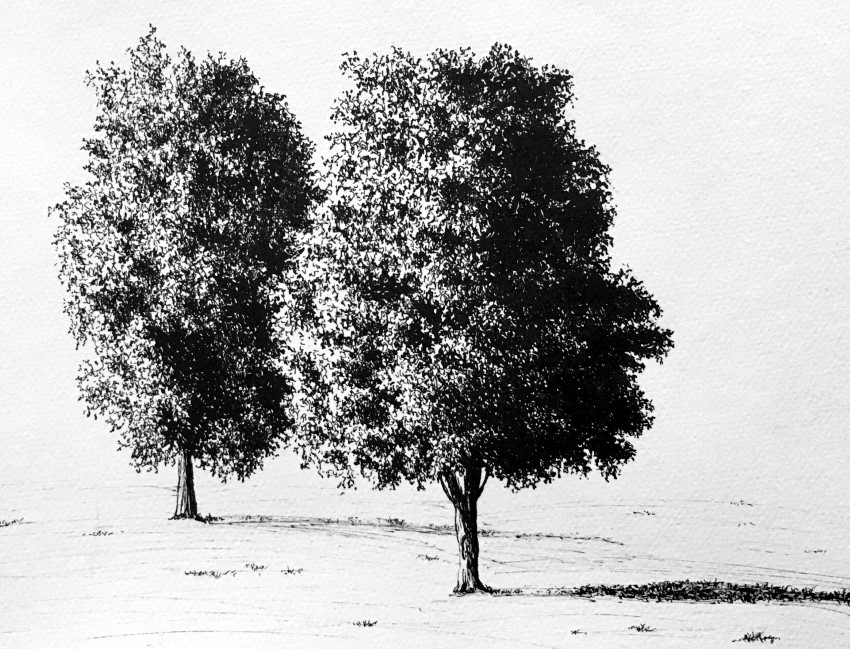 Overlapping trees
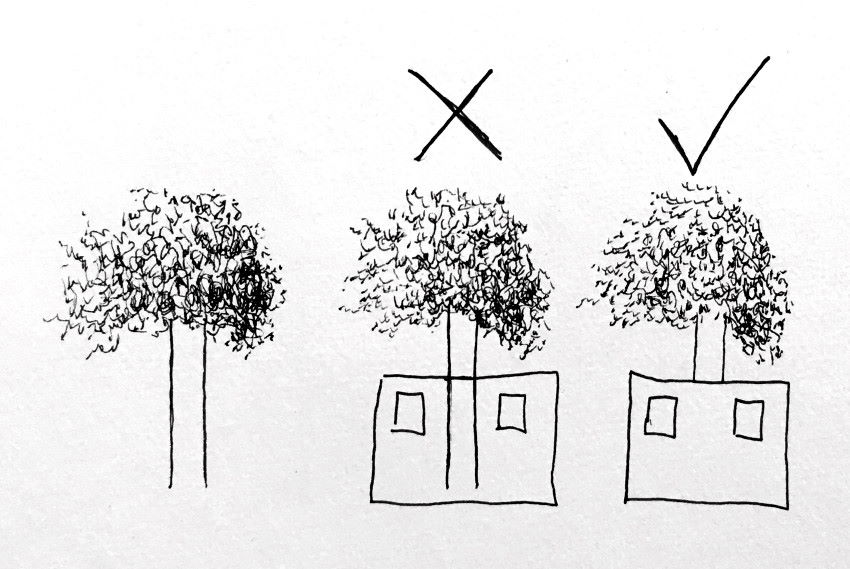
Because yous cannot erase pen marks, it is best to describe foreground objects kickoff!
If yous want to draw a house in front of a tree, draw the house get-go:
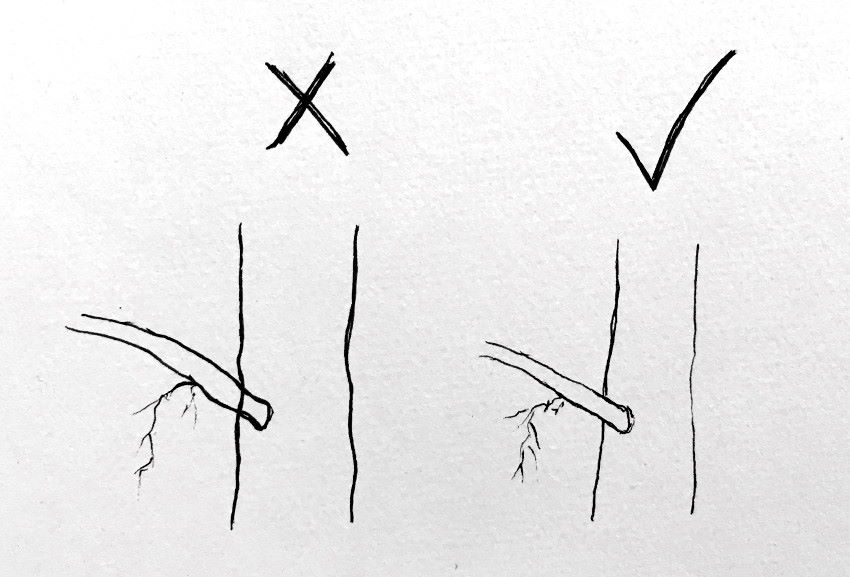
Practise the same for tree branches.
Start, draw the branch that overlaps a tree, so the tree trunk.
For trees that have a complex structure, with many branches, y'all tin can use a pencil to draw the basic shapes.
When you are happy with the issue, you can draw over it with a pen, and gently erase the pencil marks.
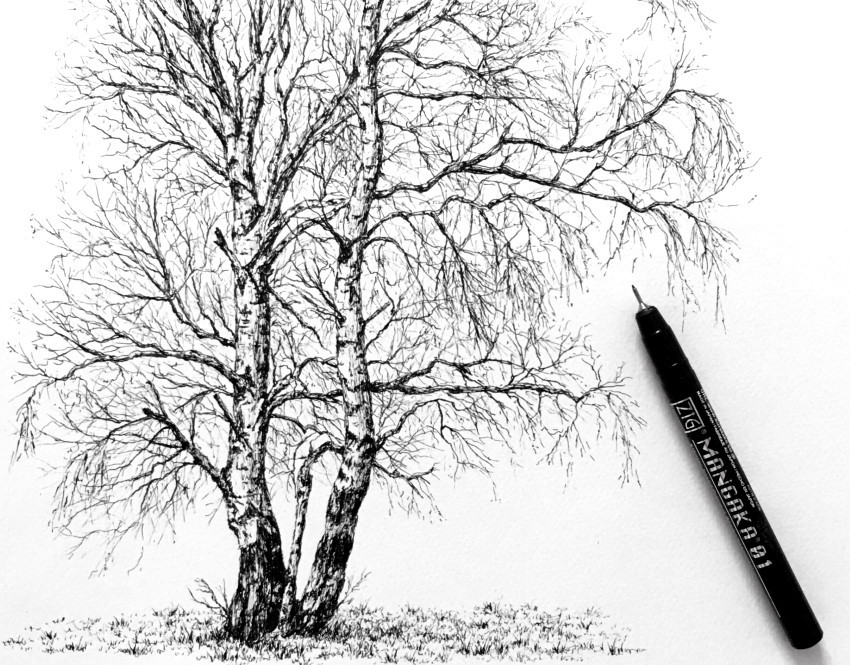 Birch copse
Transitions
Transitions are part of drawing (and painting) fundamentals. They exist everywhere!
For case, different areas of a flat plane accept different relationships with whatsoever light source, reflections, and shadows.
Therefore, always look for transitions (in effulgence values) for your cartoon to look realistic and natural.
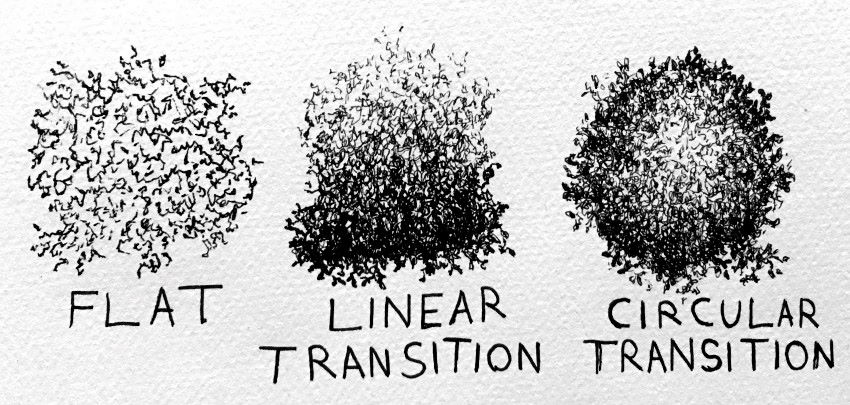
Outset, look for low-cal and dark areas.
Then, await for transitions within each area. Transitions from dark to lite, from light to lighter, and from night to darker.
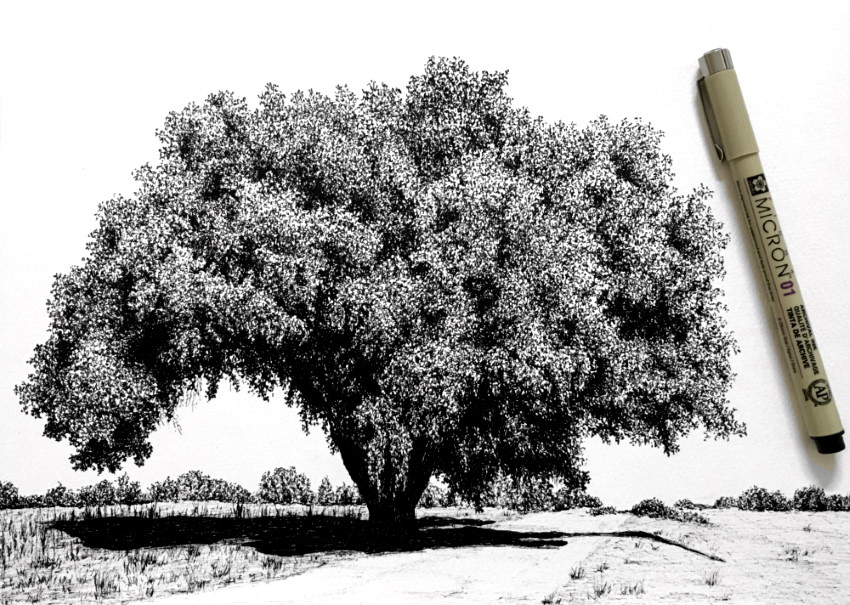 Oak tree
By drawing with NO transitions (and using hard edges), yous can create something that looks unnatural, as opposed to something realistic with transitions.
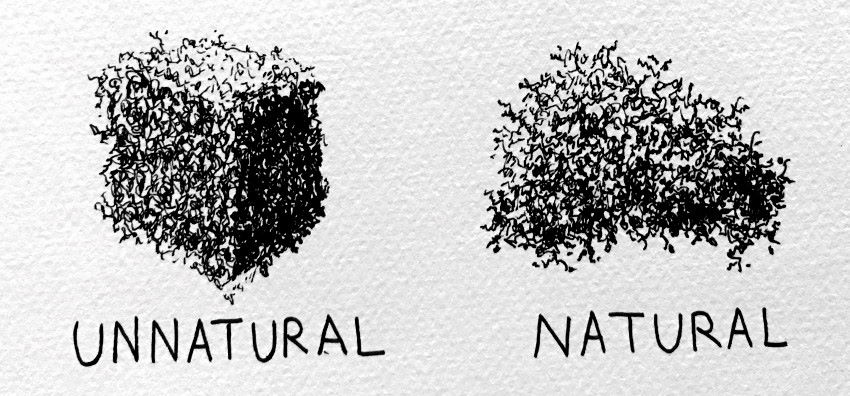
The same way a gardener trims bushes and copse, you can utilize your creative license to create something that looks artificial or homo-fabricated:
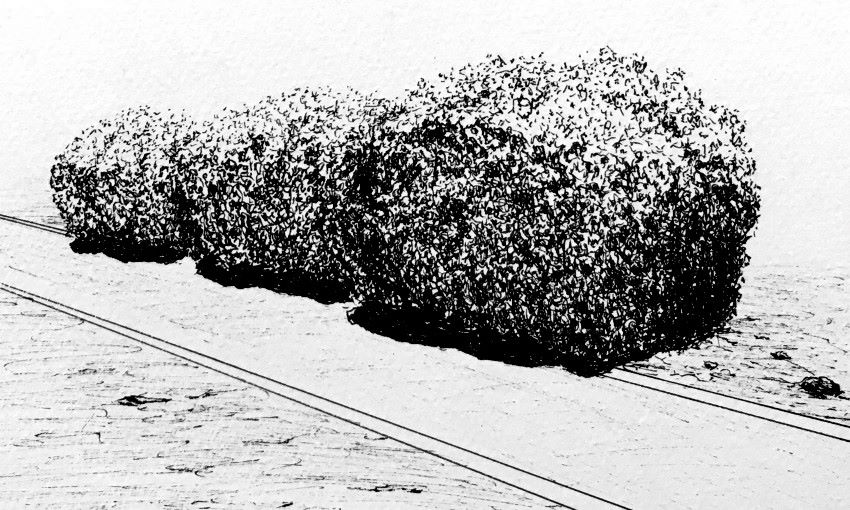
Artistic license ways to utilize your noesis and experience.
In one case you understand how to depict leaves, you can draw anything with leaves texture. Objects, figures, vehicles, or even a refrigerator:
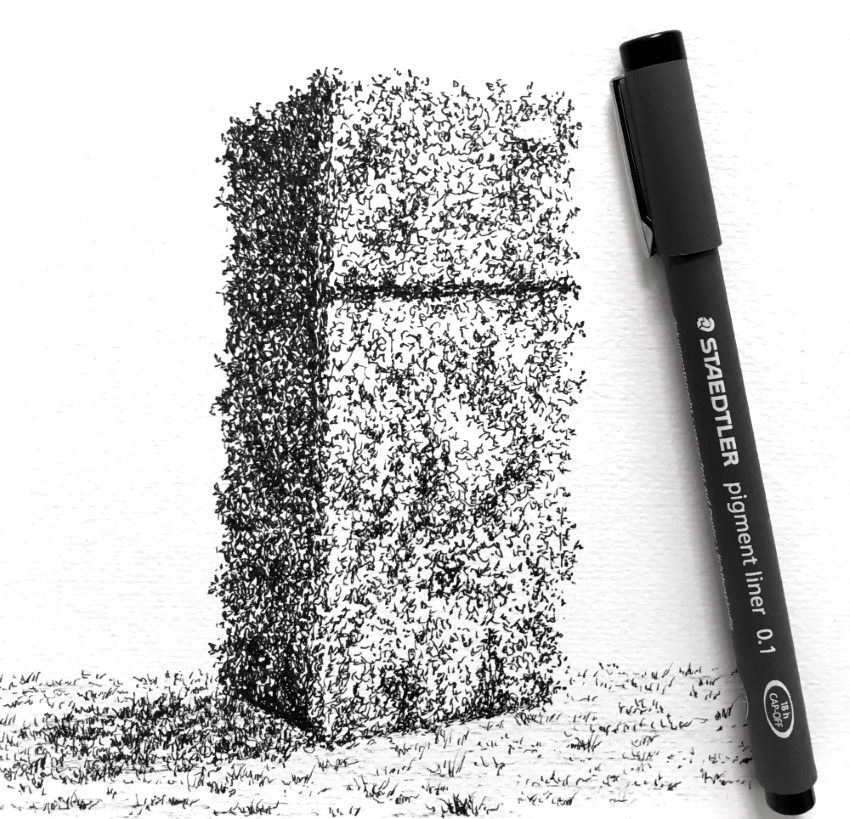
Practiced to know:
Transitions are not express to effulgence values. Transitions exist in colors, texture, edges, and temperature (transition from warm colors to cool colors).
If y'all are struggling with realistic drawing, y'all might want to read my realistic pencil-drawing guide. It covers the iv important fundamentals (accurateness of the form, effulgence values, edges, and transitions).
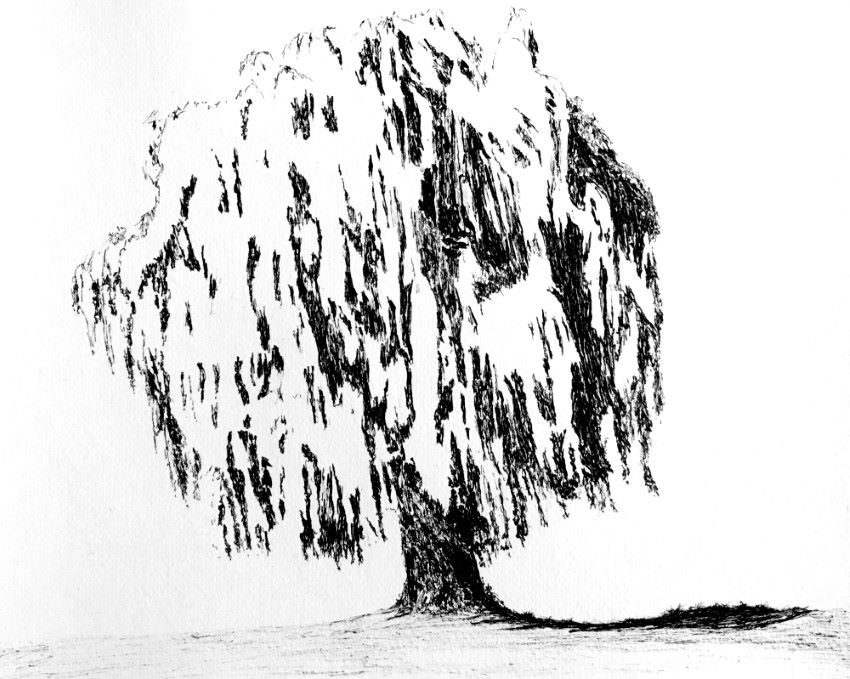
Weeping Willow
A weeping willow tree is a bit tricky to draw.
Its leaves are easy to describe at an upwardly-close wait. As you get farther abroad, you can encounter long clusters of leaves with no single leaf shape.
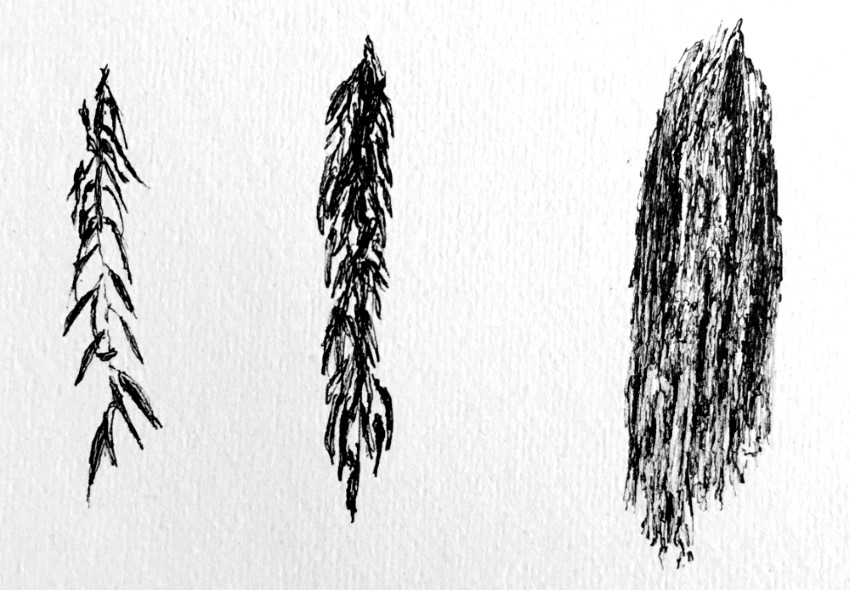
You tin can beginning by drawing an outline for the tree construction. Do it gently.
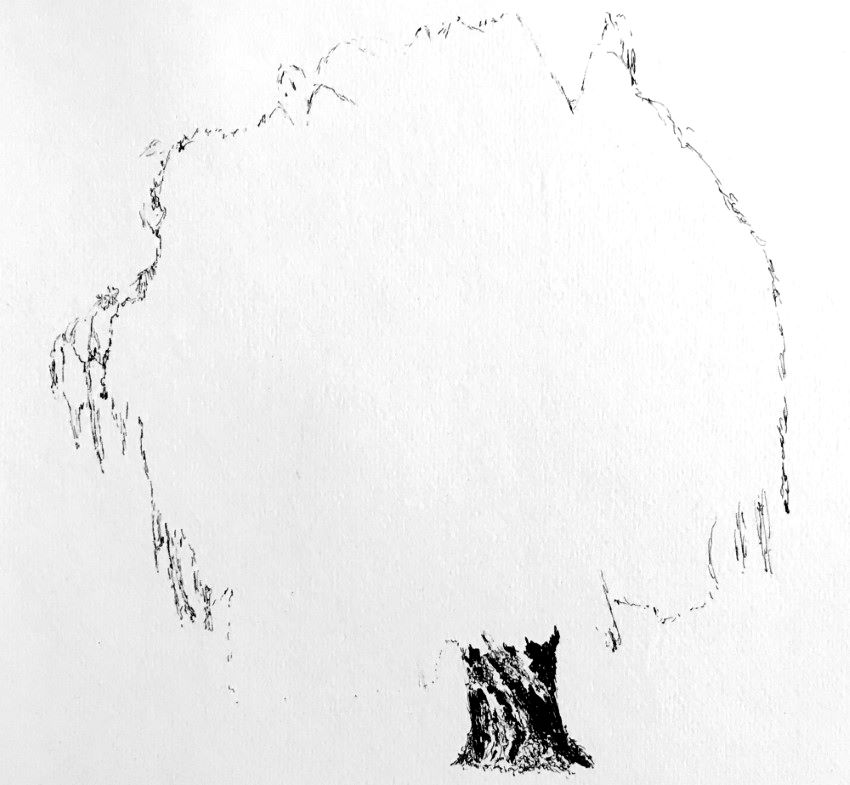
And then, i manner is to draw the treetop (crown), department by department.
Alternatively, like in this example, y'all tin draw the dark values first.
Something to consider:
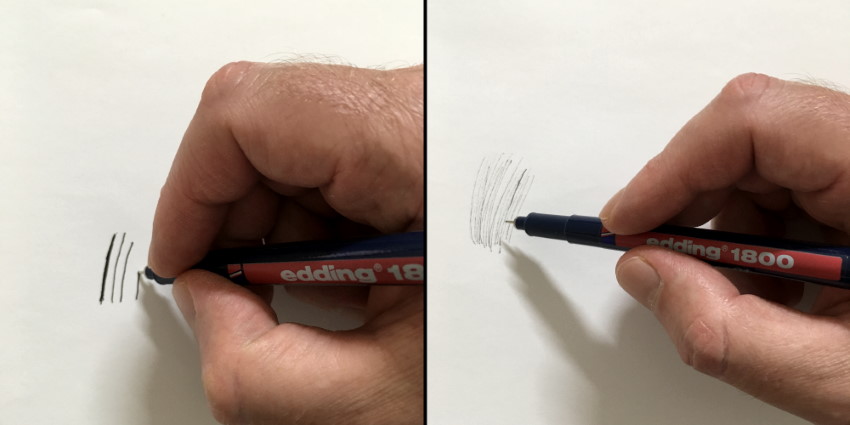
As mentioned to a higher place, a pen has ane effulgence value (ordinarily black, though other colors be, more on that later).
By drawing gently and swiftly, with a precipitous angle, you tin can produce lines that are less defined, and therefore with a lighter value.
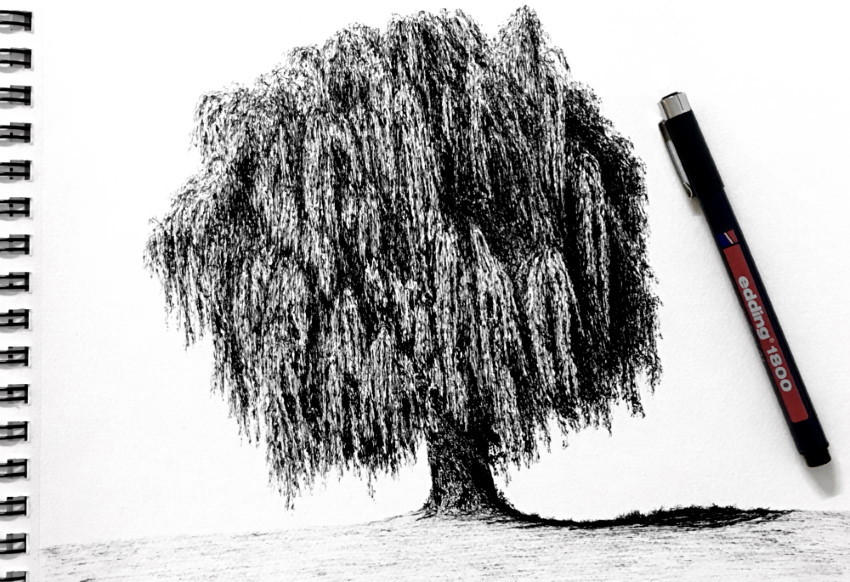
The last step is to add the light values.
Pay attention to brightness values, transitions, and texture. Be abstract with your marks, yet with a sense of direction.
 Weeping Willow
How to Draw Huge Trees
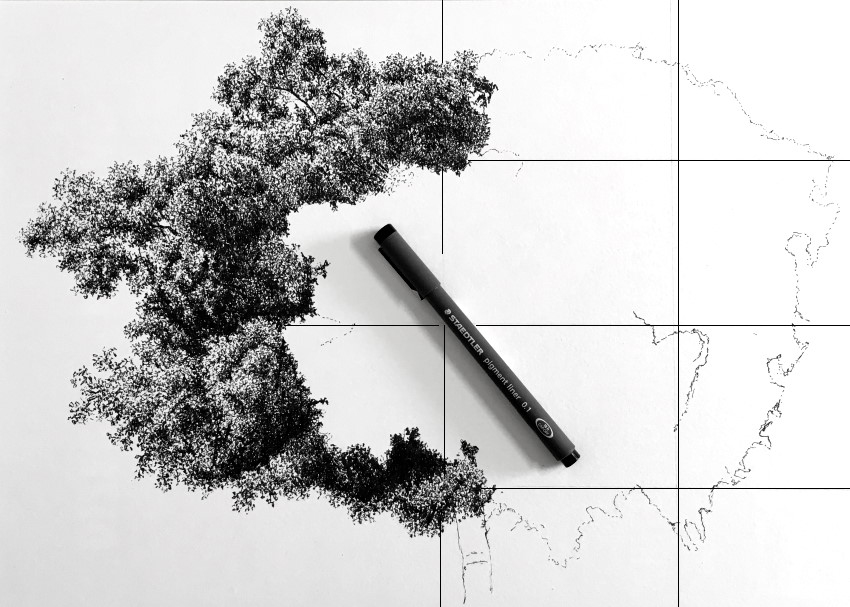
For some large trees, like Ficus, I like to use a large paper sail (A3 in this instance).
If the tree is besides circuitous to draw, you can depict a filigree (softly with a pencil), to divide the paper into smaller sections (and use the same grid for your reference epitome).
Go on in heed:
Drawing on a big paper with a pen (or a pencil) is time-consuming. For a tree like this, information technology can easily take more 20 hours to complete.
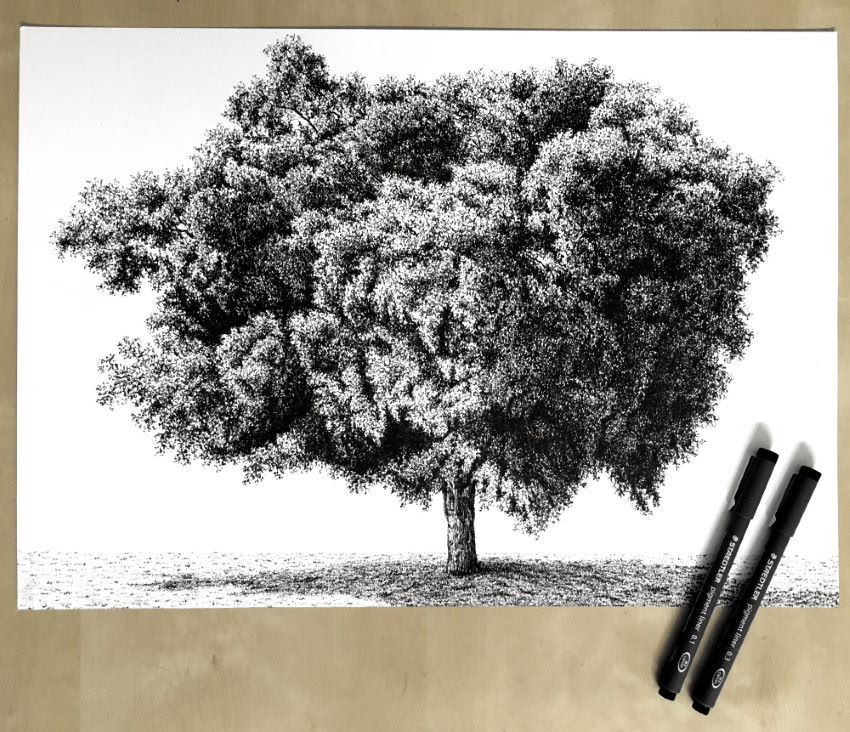 Ficus tree
Sometimes, huge drawings may not wait so big on a small screen.
You tin can give it context past adding background copse (from imagination in this instance).
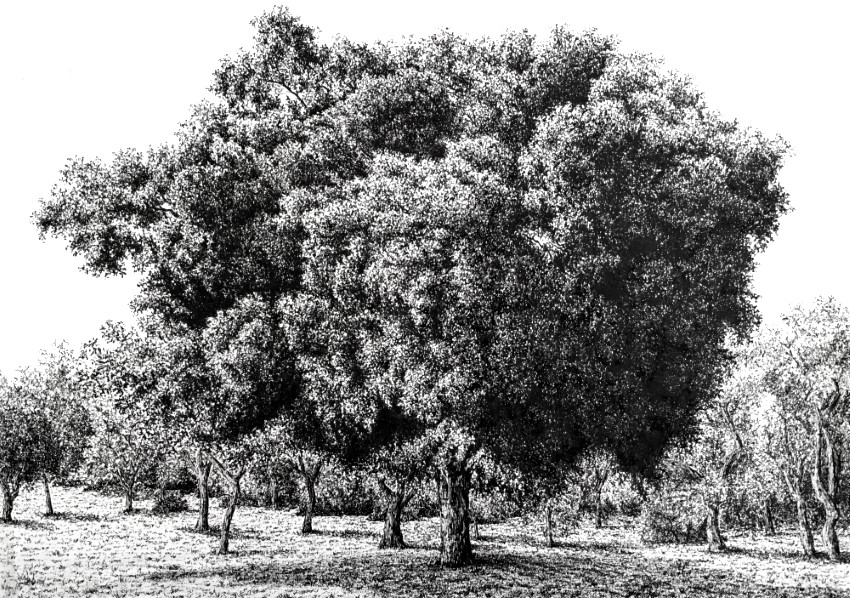 Background drawing
Something to consider:
Y'all should use the rules of atmospheric perspective when cartoon backgrounds (landscape).
When objects are far abroad, there are more temper particles (that scatter low-cal) between them and the observer.
For far abroad objects, utilise less dissimilarity and fewer details. In add-on, background layers become lighter, and take soft edges.
Calculation Groundwork
Trees are beautiful on their own. Sometimes though, you may want to add a background.
Cartoon grass is a uncomplicated and like shooting fish in a barrel solution for groundwork.
Start by cartoon some brusque lines. The lines in the front should exist a fleck bolder and longer.
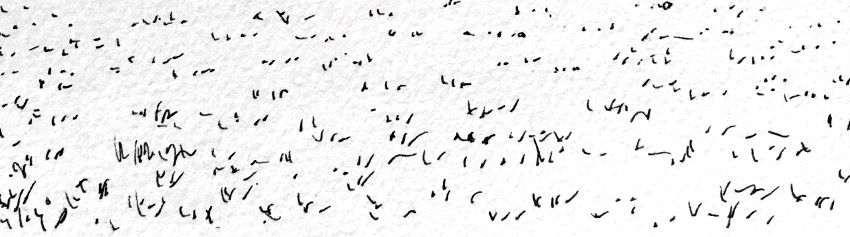
Add more lines; some can be longer (mostly in the foreground).
Avoid whatsoever blueprint, and try to be abstract with your marks.
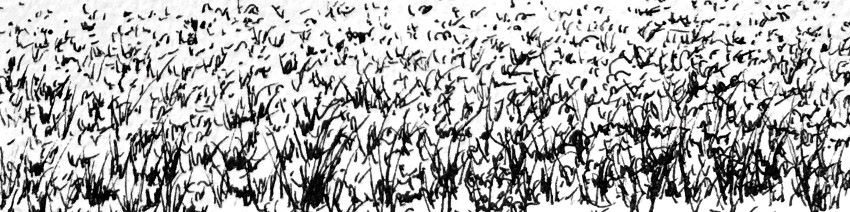
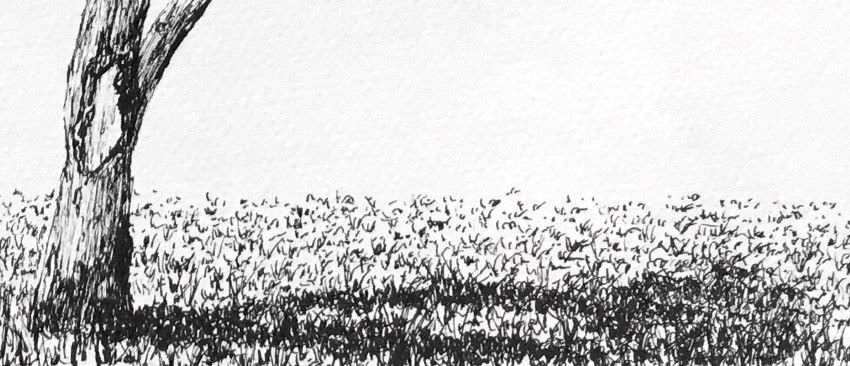
With a tree (eucalyptus in this case), grass (as background) adds depth.
There is no actual depth in a cartoon, your newspaper sheet is flat. The higher y'all depict on your paper (until the horizon), the further abroad it looks.
By drawing cast shadow past the tree, you can add a sense of space to your cartoon.
To describe cast shadow, add together more marks (lines) for that area, to create the illusion of dark value.
Calculation Plants
Another option is to add some plants. For example, cattail institute (Typha).
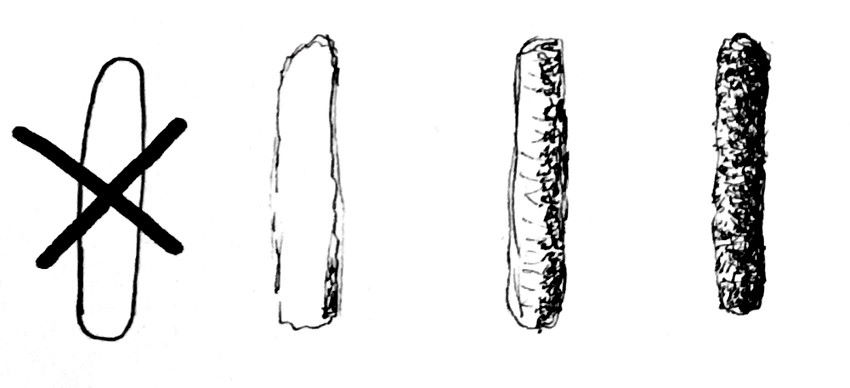
Remember:
Natural plants and trees have an abstract shape. Brand sure yous do not draw them besides round and uniform.
When drawing long leaves, pay attention to cast shadows:
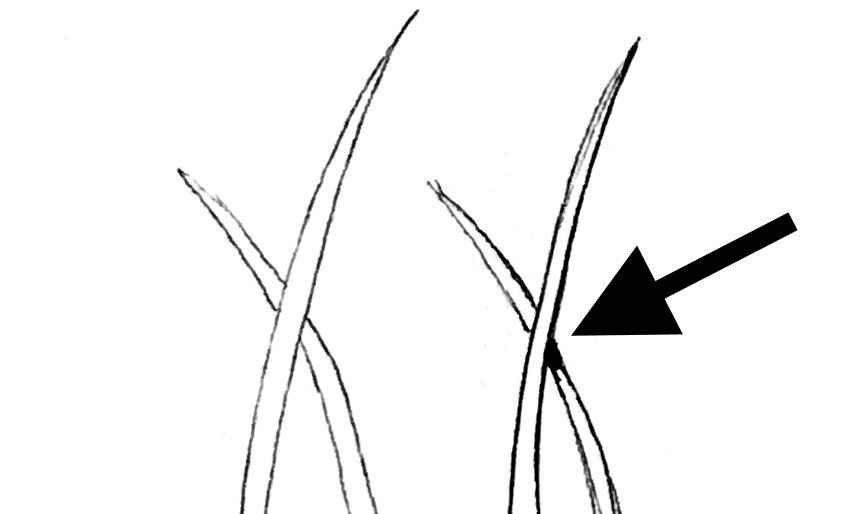
After test-drawing the plant's parts, draw some loose outlines.
For realistic results, draw each flower or leaf with dissimilar size, shape, and direction (merely, keep in listen the tree or plant characteristics).
Additionally, pay attention to overlapping.
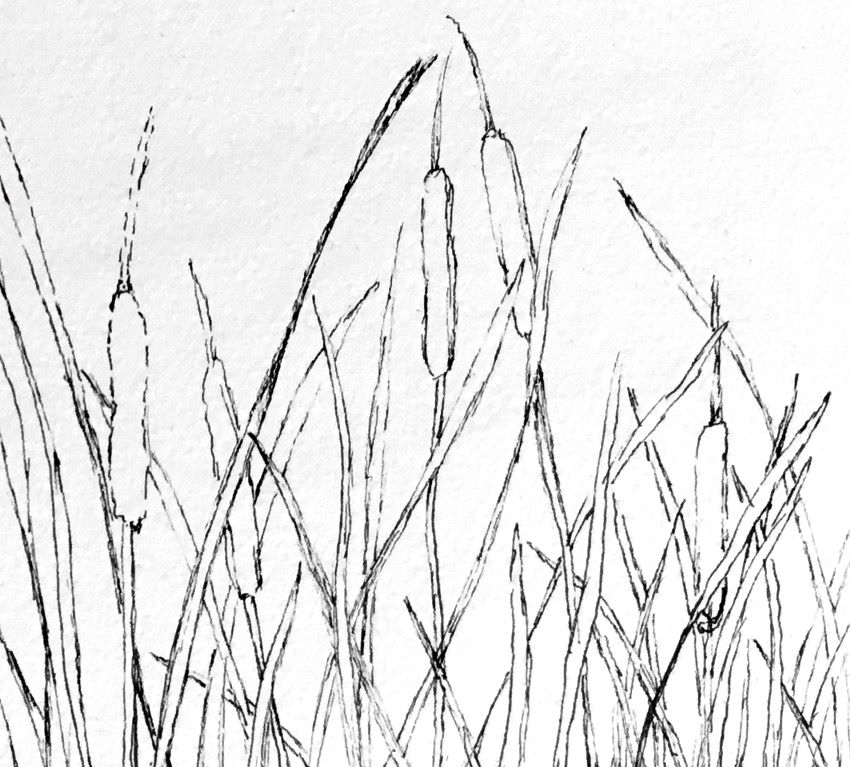
And then, add some brightness values and cast shadows.
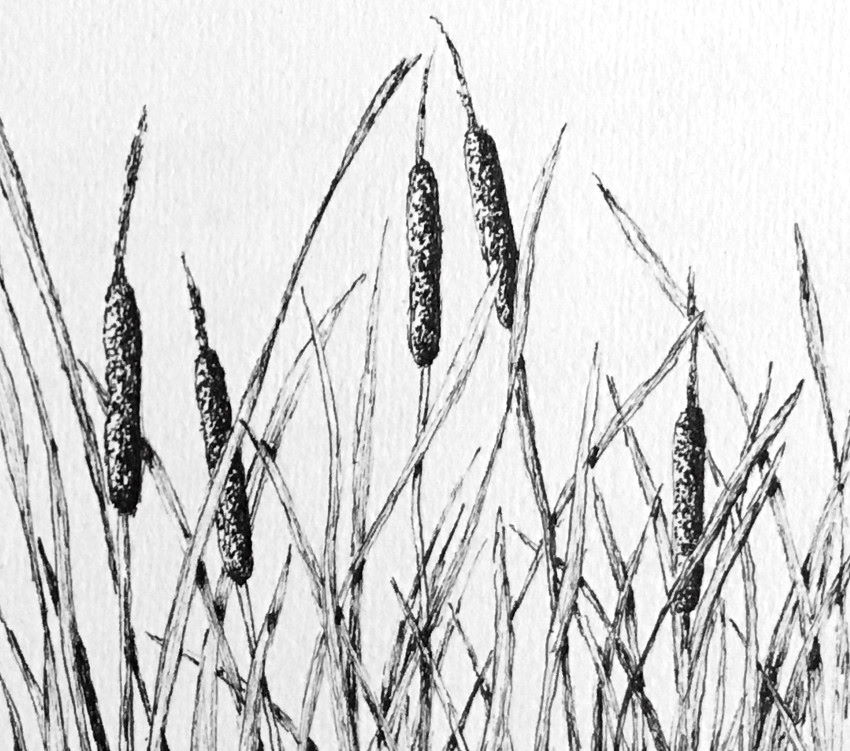 Cattail
Now you can combine grass and plants to draw a landscape.
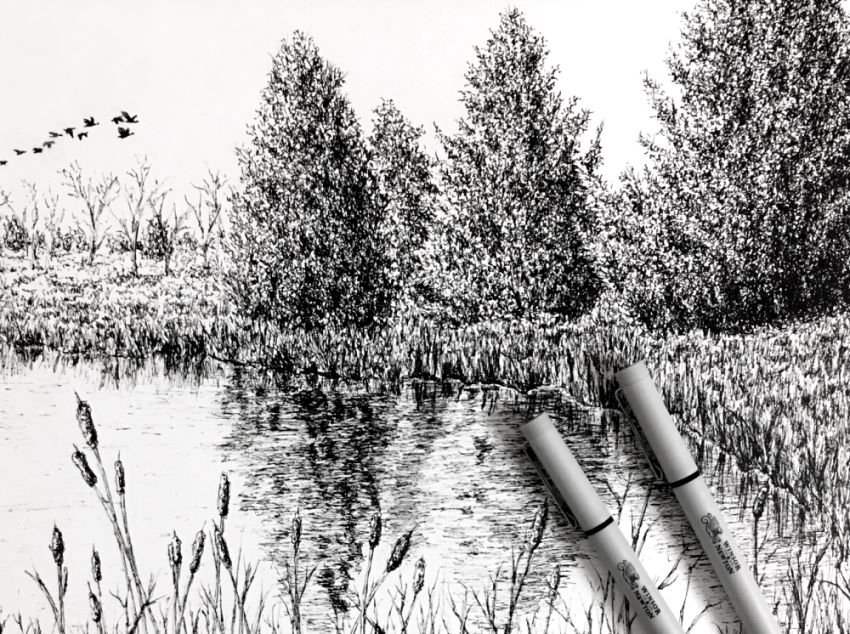 Mural pen drawing
And, pigment it with markers.
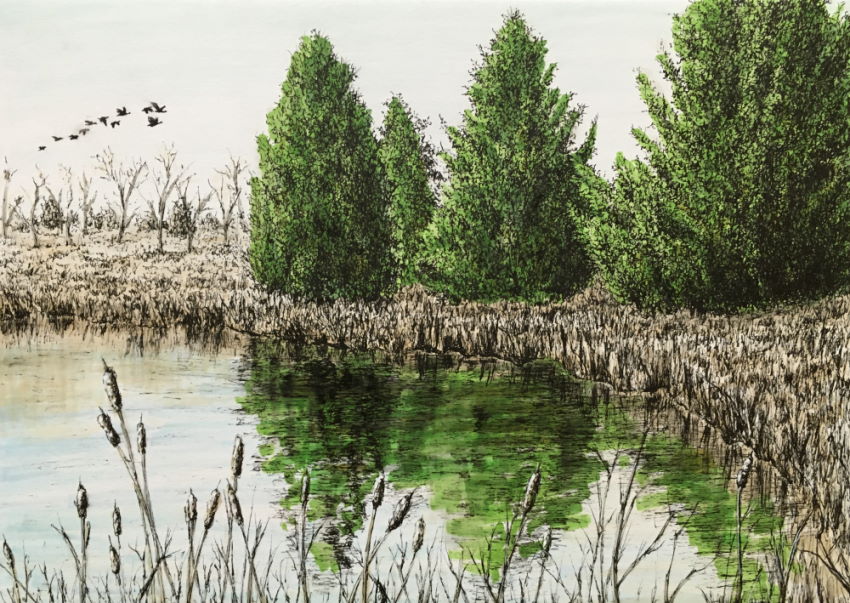 Coloring with markers
Size & Context
The way to define the size of objects is by placing them almost other familiar objects.
Although a worm is commonly quite minor, by drawing it large compared to known objects like copse, it is possible to create a giant monstrous worm.
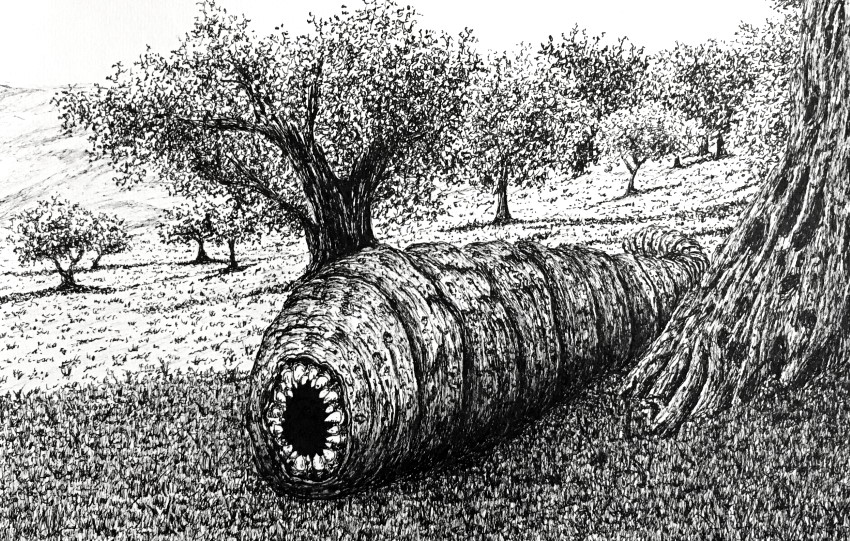 Behemothic worm
On the other hand, yous might want to draw a small tree, like a bonsai tree.
In this case, you lot need context.
Drawing a tree in a plant pot tin can help, but sometimes even large trees are sold within pots.
Drawing familiar surroundings, like a room, can help a lot in defining the bonsai's size.
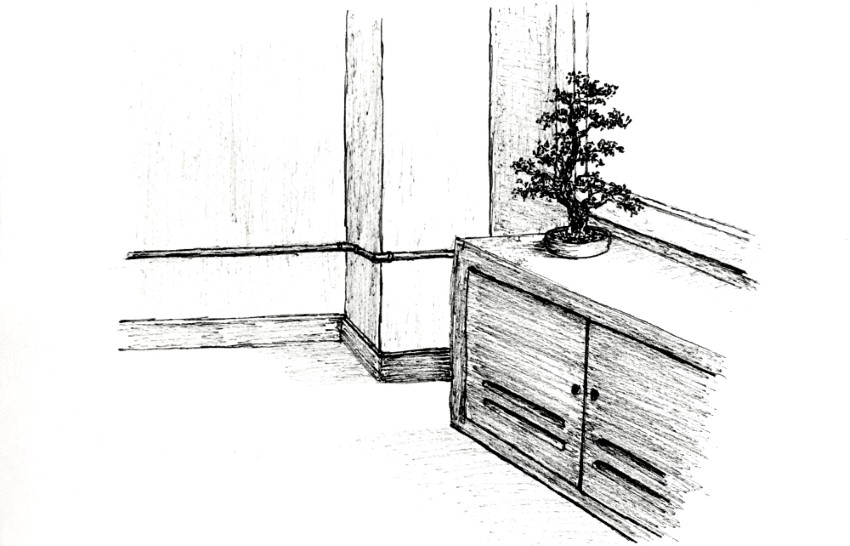 Bonsai tree
Colored Pens
While the main colour for technical pens is black, many brands offer other color options.
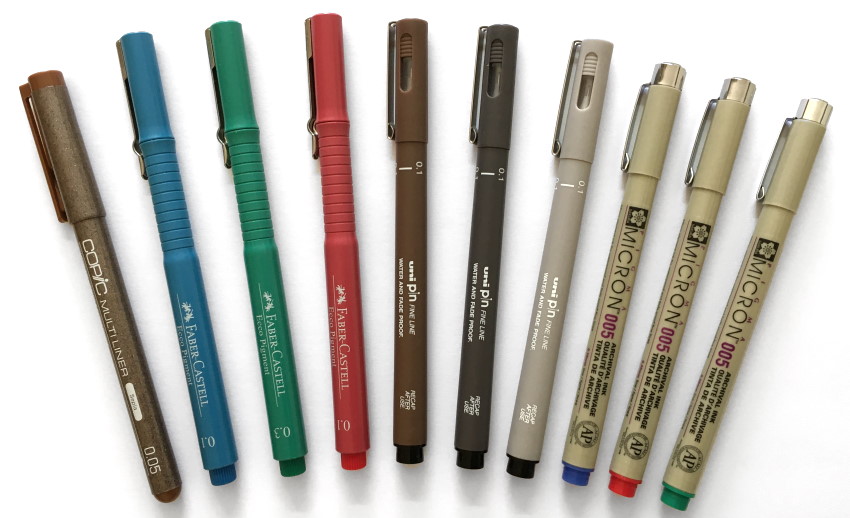 Colored technical pens
I adopt black ink, just occasionally I like to mix it up with colors.
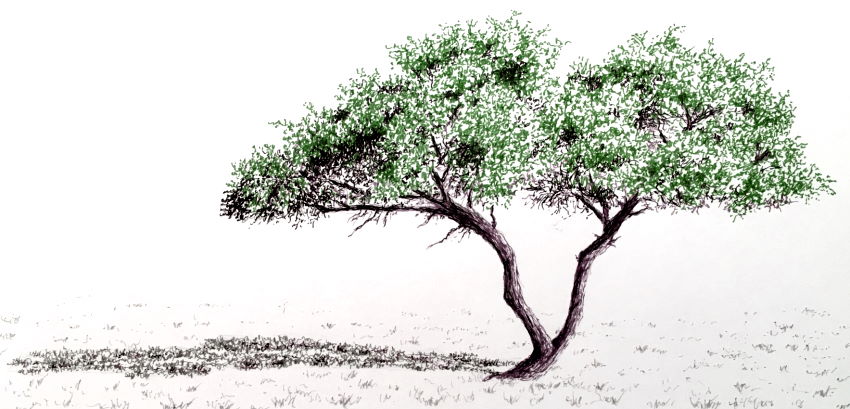 Acacia tree
Log
To draw logs, timber, or tree trunks, start by drawing the outlines gently.
Pay attending to foreshortening, and add some bones details.
Lastly, make up one's mind where to identify the calorie-free source, and describe a gradual transition in brightness values with sketchy marks.
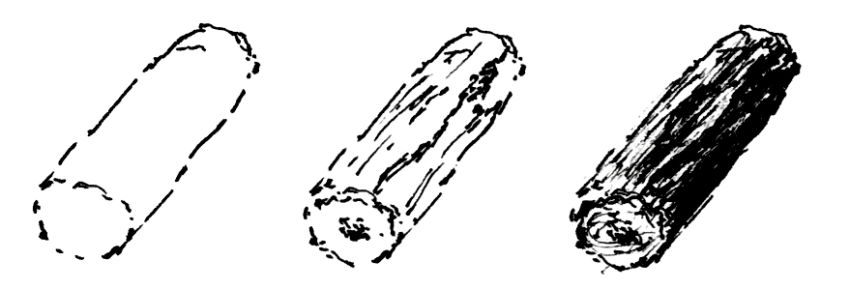
Transitions:
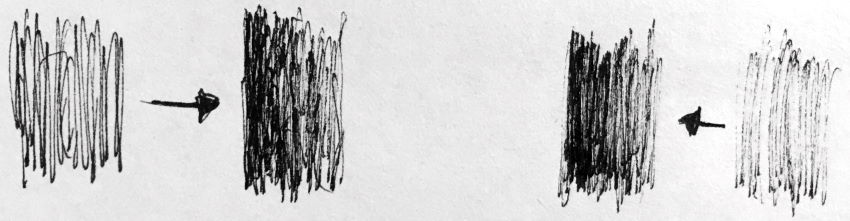
A cylindrical object has a transition in brightness values, from nighttime to light.
When using a black pen, draw more lines for darker areas.
Another choice is to draw less defined lines (swiftly at an angle), and add together more lines for darker values.
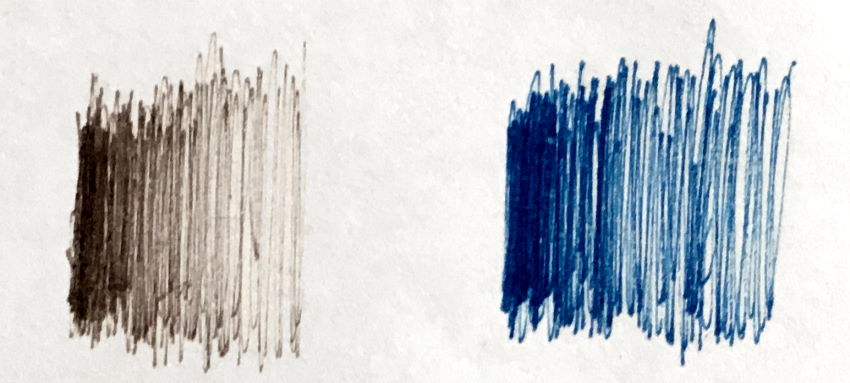
Colored pens:
Different black pens, colored pens come in dissimilar levels of opacity.
When cartoon more in the same area, the pen creates a darkness value. Sometimes you lot can let the pen ink dry, and then draw over it again.
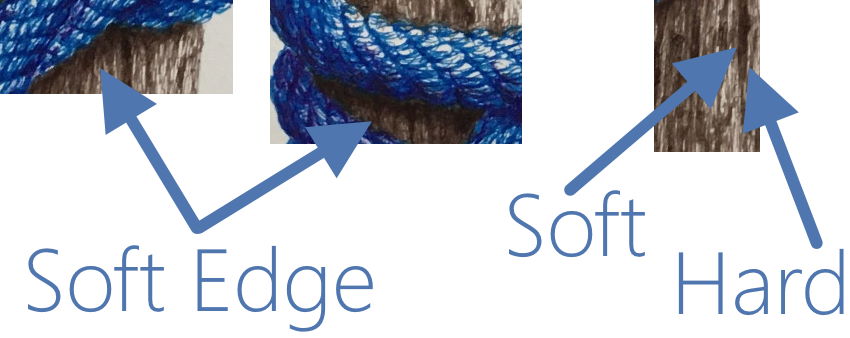
Edges:
Bandage shadows usually have soft edges (see below how the bandage shadow from the rope has a soft edge).
When yous scribble the wood texture, yous desire to have some dents and holes in some areas.
Draw these dents with a difficult edge on their darker role, and a soft border when the transition ends (the lite side of the dent, or hole).
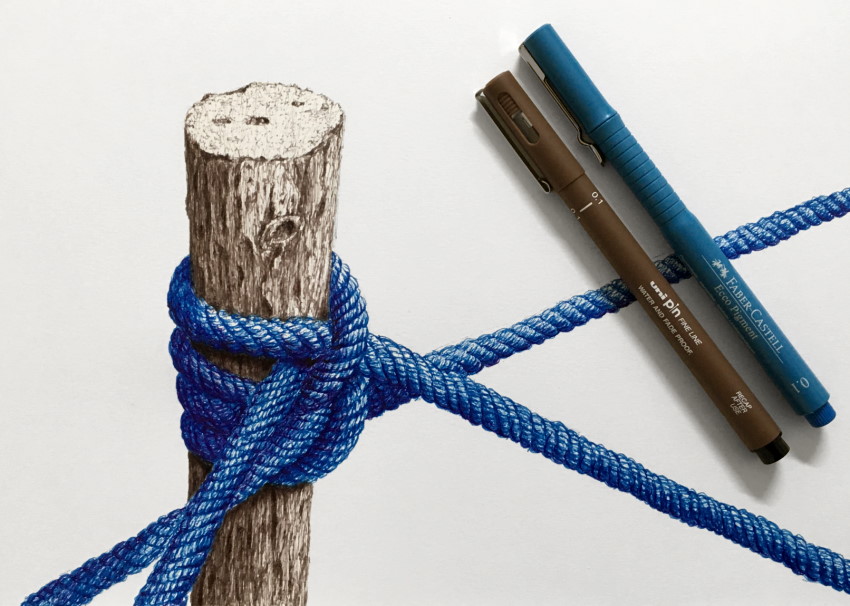
For a more realistic rendering, with more than details, depict big.
Summary
While in that location are no lines in nature, pens can only create lines!
Drawing is creating an illusion. The world is iii-dimensional, but your paper-sheet is 2-dimensional.
To create this illusion, pay attention to brightness values, edges, and transitions (amid other things).
A pen has just one brightness value, and so, unlike other drawing mediums (graphite, charcoal, pastel...), you have to create the illusion of different brightness values and transitions (in effulgence values).
When drawing copse, focus on accurateness of the form, and on effulgence values.
Make sure you have enough contrast between highlights and shadows, for the cartoon to be noticeable.
After you master cartoon the form and brightness values, details (texture) brand all the difference.
If yous liked this commodity, you might like my blossom pen-cartoon guide too.
For my recommended pens that I used in this guide, visit my review for fineliners and technical pens for cartoon.


Copyright © RanArtBlog.com. All Rights Reserved. | Sitemap

Source: https://ranartblog.com/blogarticle10.html
Posted by: cashhincir.blogspot.com
0 Response to "How To Draw A Realistic Robot"
Post a Comment